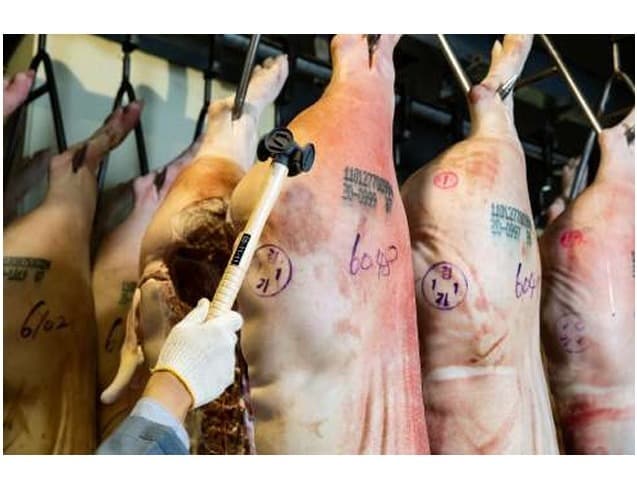
Understanding Meat Correctly / Basic Knowledge of Meat
MEAT ECONOMICS ① Cow | The Value of a Whole: The Economics of a Whole Hanwoo… From One Carcass to ‘Meat’
From grade to cut, meat yield, aging, and export… A look into the commercial value of a single Hanwoo cow

The reason why slaughtered cattle are assigned two grades
Beef grades are largelyMeat quality grade and meat yield gradeIt is divided into.

Simply put, meat quality grades can be viewed as evaluations related to the quality characteristics of the meat, while meat yield grades relate to the amount of meat obtainable from a carcass. To understand the economic value of a single animal, it is necessary to examine not only the meat quality grades familiar to consumers but also the actual meat production volume.
Not all 100kg of a carcass becomes meat.
The book introduces examples of the amount of lean meat obtained from each major part of an animal, excluding internal organs and bones.
The carcass weights of the three presented cases were 254.51 kg, 365.13 kg, and 347.89 kg, respectively. Among these, the total weight of the 10 major cuts—tenderloin, loin, striploin, neck, foreleg, round, round, brisket, shank, and ribs—was 177.42 kg, 266.25 kg, and 241.05 kg, respectively.
When viewed as a ratio relative to the carcass weight, each69.71%, 72.92%, 69.29%c. In the examples presented in the book, approximately 69 to 73 kg out of 100 kg of carcass was produced as the 10 major cuts.
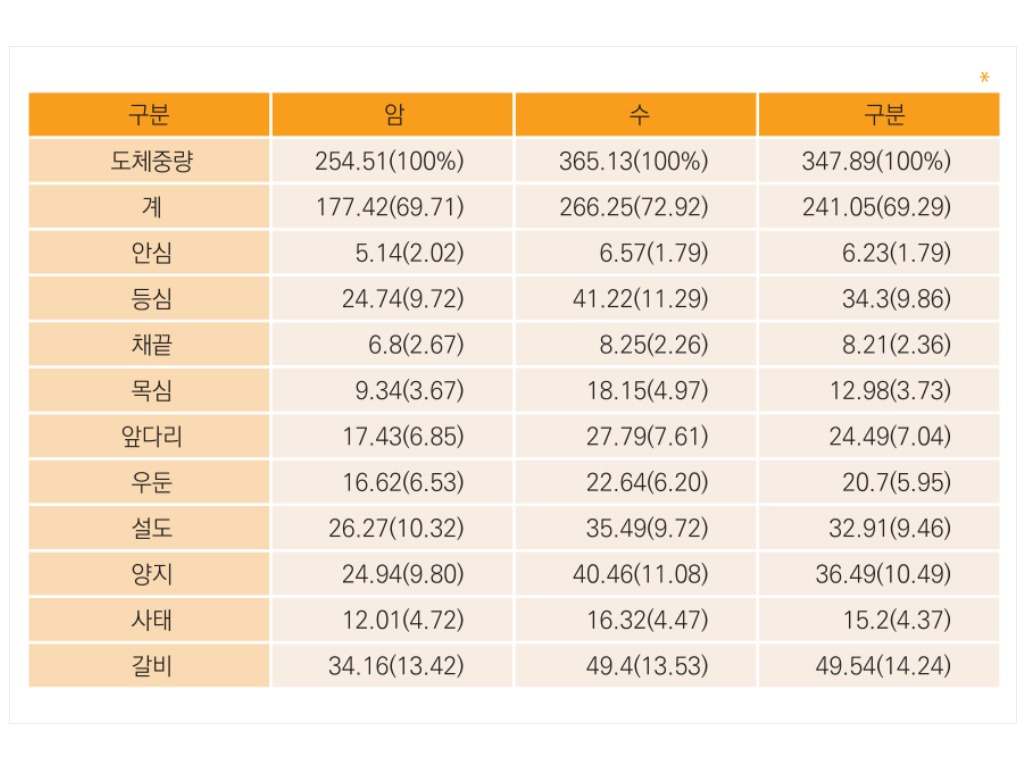
It is the same animal, but the tenderloin is 6kg and the ribs are 50kg
When understanding the commercial value of a single Hanwoo cow, what is important isThe fact that production volume by part is not at all the sameam.
In the case of a carcass with a weight of 347.89 kg, ribs accounted for 49.54 kg, or 14.24% of the carcass weight. Brisket was 36.49 kg, loin was 34.30 kg, and round was 32.91 kg. On the other hand, tenderloin was 6.23 kg, or 1.79%.
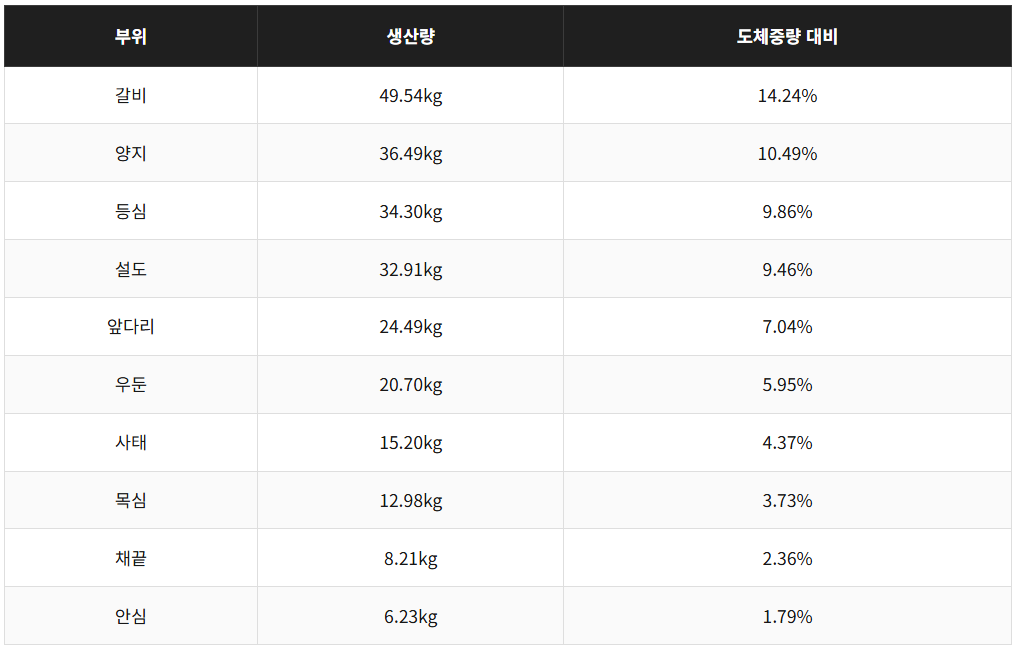
The price of different cuts of beef is not determined by ‘taste’ alone.
The amount produced from one animal and the demand in the market together create value.
10 parts back to 39 products
Beef separated from the carcass does not end with the 10 major cuts. It undergoes a further process of detailed subdivision. The book introduces a total of 39 subdivisions of beef.
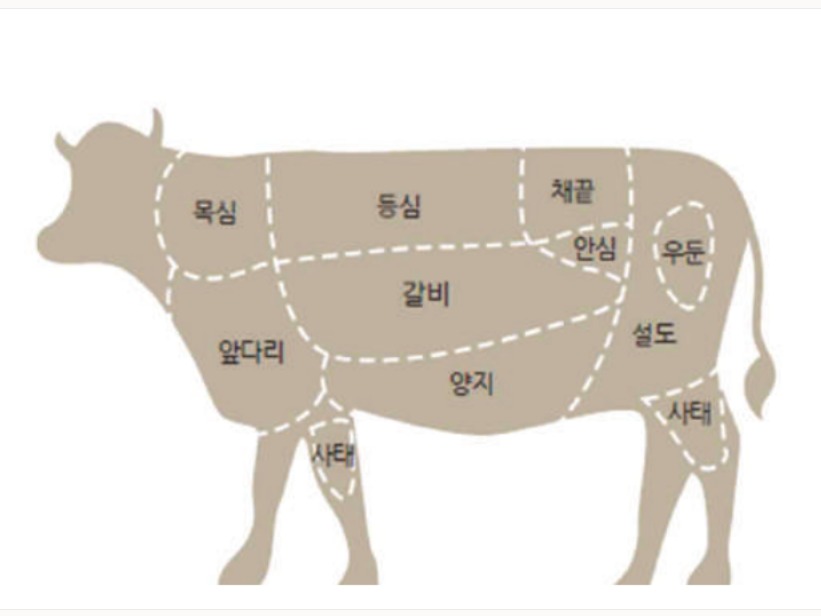
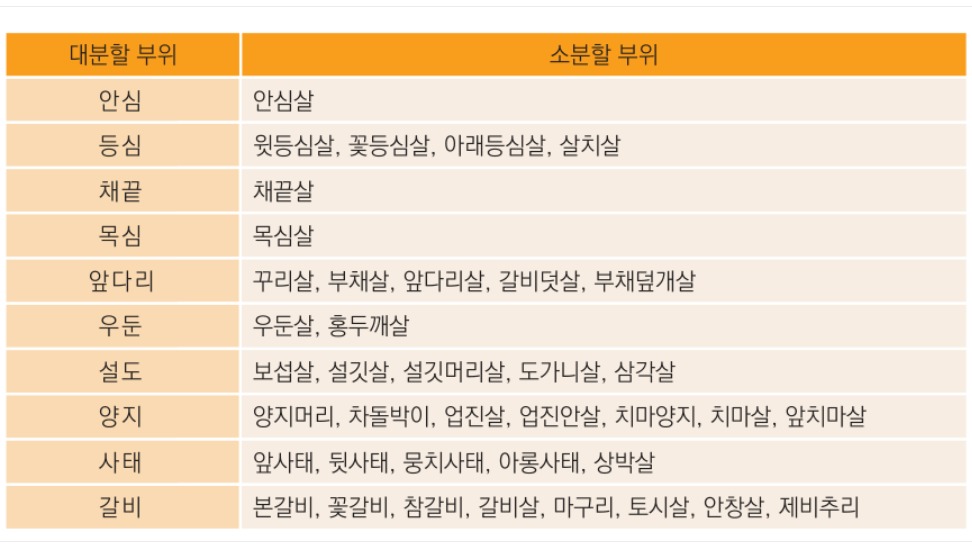
The sirloin is subdivided into upper sirloin, ribeye, lower sirloin, and chuck tender, while the foreleg is subdivided into shank, fan steak, foreleg meat, rib cap, and fan cover meat. The brisket yields brisket head, short rib, flank steak, flank inner steak, skirt brisket, skirt steak, and front skirt steak.
at last One cow does not become a single beef product.A single conductor undergoes shaping and division, transforming into dozens of products with different characteristics and uses. From this point, a ‘major economics’ begins.
Just because the quantity is small doesn't mean it's expensive.
While scarcity is an important factor in determining the commercial value of a cut, it cannot explain the price alone. Tenderness, flavor, cooking suitability, and consumer preferences also play a role.
The book describes the tenderloin as the softest cut among beef cuts. In the shear force comparison presented in the book, the tenderloin was the lowest at 2.34, followed by the sirloin at 3.24, striploin at 3.62, brisket at 3.99, foreleg at 4.61, neck at 4.84, and round at 5.47.
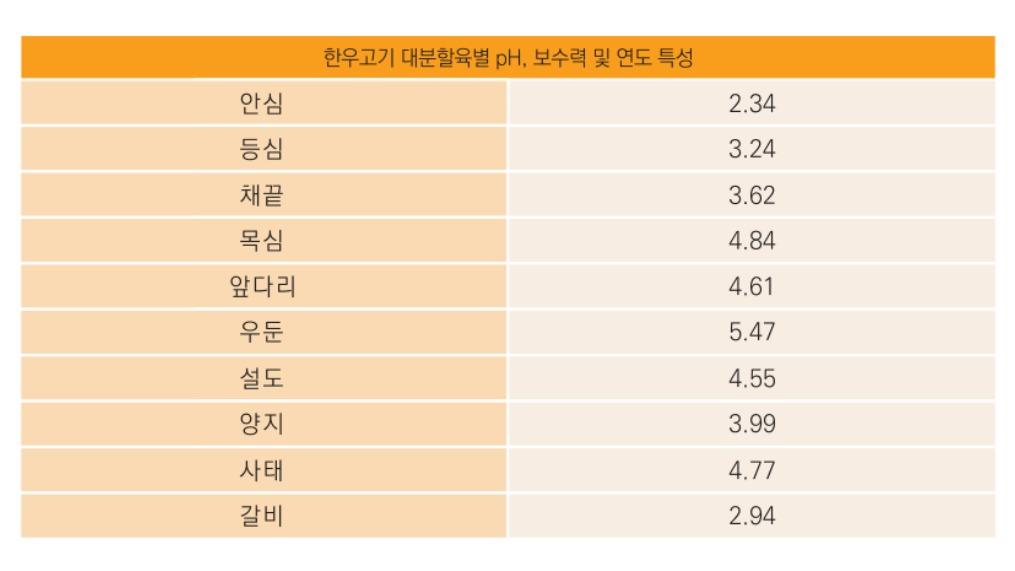
Tenderloin is produced in very small quantities from a single animal and possesses the characteristic of being relatively tender. Conversely, even cuts with high production volumes form different markets depending on their intended use, such as for grilling, stews, braised meat, or soups.
Products continue to be produced even after ‘ribeye’.
Commercialization is not finished simply because the official division of cuts is complete. In the actual distribution and food service markets, new product names are created based on factors such as marbling, aging methods, cutting shapes, thickness, and intended use.
The source materials explain expressions like "Seolhwasal" not as legal cut names, but as marketing terms that liken the meat's excellent marbling to snowflakes. In essence, even with the same raw meat, it becomes a completely different product depending on how it is butchered and what name or use is assigned to it.
Aging adds value to beef once again.
Dry aging, one of the representative aging methods, is a process of drying and aging meat while managing a constant temperature, humidity, and airflow.
The book is a general environment1~3℃, relative humidity 70~80%, air flow 2~5 m/sIt introduces the back and explains that the aging period is at least 10 days to a maximum of about 60 days.
However, a high meat quality grade does not necessarily mean it is more suitable for dry aging. The source material explains that when dry-aging high-fat meat for an extended period, factors such as fat oxidation must be considered in addition to the aging effect.
Even for the same beef, evaluation methods differ by country.
Korea, the United States, and Japan all operate beef grading systems, but their standards and labeling methods differ. Korea uses meat yield grades A, B, and C, and meat quality grades 1++, 1+, 1, 2, and 3, while Japan combines meat yield grades A, B, and C with meat quality grades 1 through 5. In the United States, the USDA operates a Yield Grade system separate from meat quality grades such as Prime, Choice, and Select.
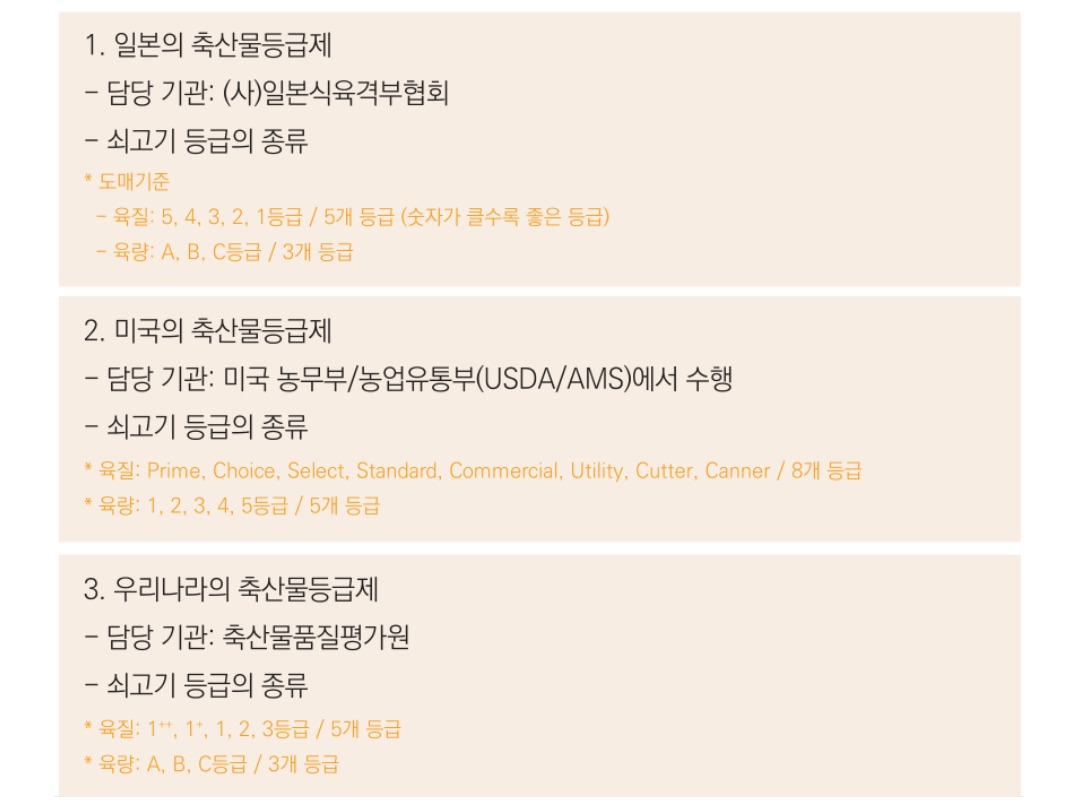
Domestic Hanwoo Products Now Heading to Overseas Markets
The commercialization of Hanwoo does not end in the domestic market. HanwooFirst export to Hong Kong in November 2015It was done, and in 2023, Malaysia and Cambodia were added.
Overseas, the joint Hanwoo brand logo is used to allow local consumers to identify the product as Hanwoo, and methods for verifying information via QR codes are also introduced.
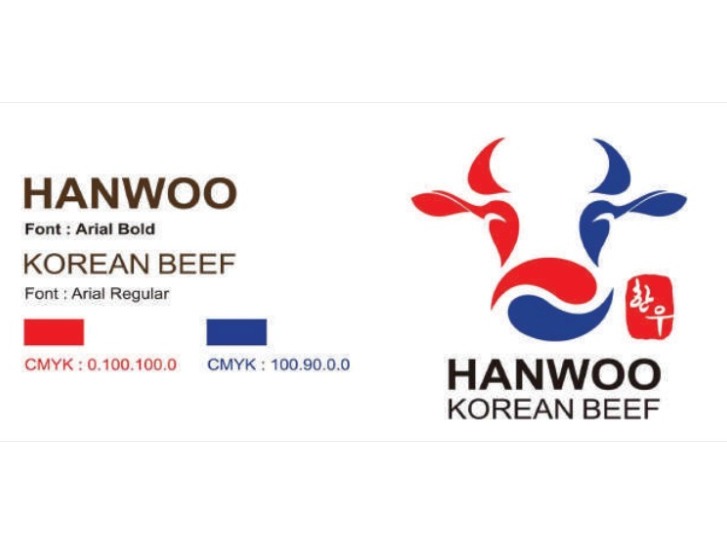
The ‘composition of one’ is more important than the price of one
When discussing the price of Hanwoo, we commonly think of the wholesale market auction price or the price per kilogram first. However, to properly understand the economic value of a single head, we must look at the next step.
The value of the products that can be produced from a single animal varies depending on how heavy the carcass is, how the meat quality and quantity are evaluated, how much actual meat is produced, how much of each cut is obtained, and which cuts consumers look for.
In addition to this, shaping, aging, branding, and the sales market are added.
What matters regarding a single cow is not merely the weight of the carcass produced. The economic viability of that animal is determined by how effectively that carcass can be divided into various products and how the value of each can be realized in the market.
The process of one carcass becoming ‘meat’ is the process by which the Hanwoo industry creates the value of one animal.

- #축산물
- #유통
- #품질관리
- #기술