
Meat Culture & Trends
Marinated beef is being pushed off the dining table... The 'land of grilled meat' is turning into the 'land of solo dining'.
Seoul National University Food Business Lab 『2026 Food Trends』 Marinated Beef Edition Analysis
The landscape of meat consumption among Koreans is quietly but distinctly being reshaped. Chapter 3 of *2026 Food Trends*, titled "Exploring Meat Consumption Suitable for Eating Alone," published by Seoul National University Food Business Lab (Professor Moon Jeong-hoon) in collaboration with Food Journal, tracked changes in the consumption of seasoned meat across 20 detailed menu items from four livestock species—beef, pork, chicken, and duck—based on three years of data from Open Survey Food Diary (June 2022–May 2025).
The conclusion is simple. While spicy marinated pork and chicken are growing as convenience foods, it was difficult to find beef menu items with growth potential from the perspective of marinated meat.
The introduction to this chapter addresses a more fundamental shift. While the fresh meat and processed meat markets have grown due to increased interest in protein intake, the frequency of "grilling" meat itself is decreasing. The diagnosis is that Korean-style grilled meat, once a symbol of social dining, is fading away, replaced by a stronger trend of "eating alone," with the "one hand, one dish, one bowl" consumption patterns being applied directly to meat as well. The authors identify "meat rice bowl convenience foods"—where seasoned meat is placed over rice—as a noteworthy trend; however, they point out that the market size remains small due to the challenges of product design, which requires packaging both rice and seasoned meat simultaneously, and temperature control. The assessment that CJ CheilJedang's "Cupban" series appears to have entered the decline phase of its product life cycle also draws attention. This suggests that the market is awaiting meat rice bowl convenience foods in new forms and with different temperature settings.
01
Total marinated beef: Declining for 3 consecutive years, convenience foods showing a steeper decline
The total frequency of consumption of seasoned beef (number of appearances per 10,000 cases) has decreased for three consecutive years. During the same period, the consumption of convenience foods dropped even faster, falling from about 40 to 35 and then to 29. This means the rate of decline in convenience foods is greater than the overall rate of decline.
Looking at the breakdown by preparation method for 2024 and 2025, home cooking accounts for 39%, dining out 39%, convenience food 14%, delivery/takeout 3%, and other 5%. What is noteworthy is the trend. The proportion of home cooking dropped from 43% in 2023 and 2024 to 39%, while dining out rose from 34% to 39%. Convenience food followed a downward curve for three consecutive years, falling from 17% to 17% to 14%. The center of gravity for beef is shifting from cooking at home or buying convenience food to consuming it outside.
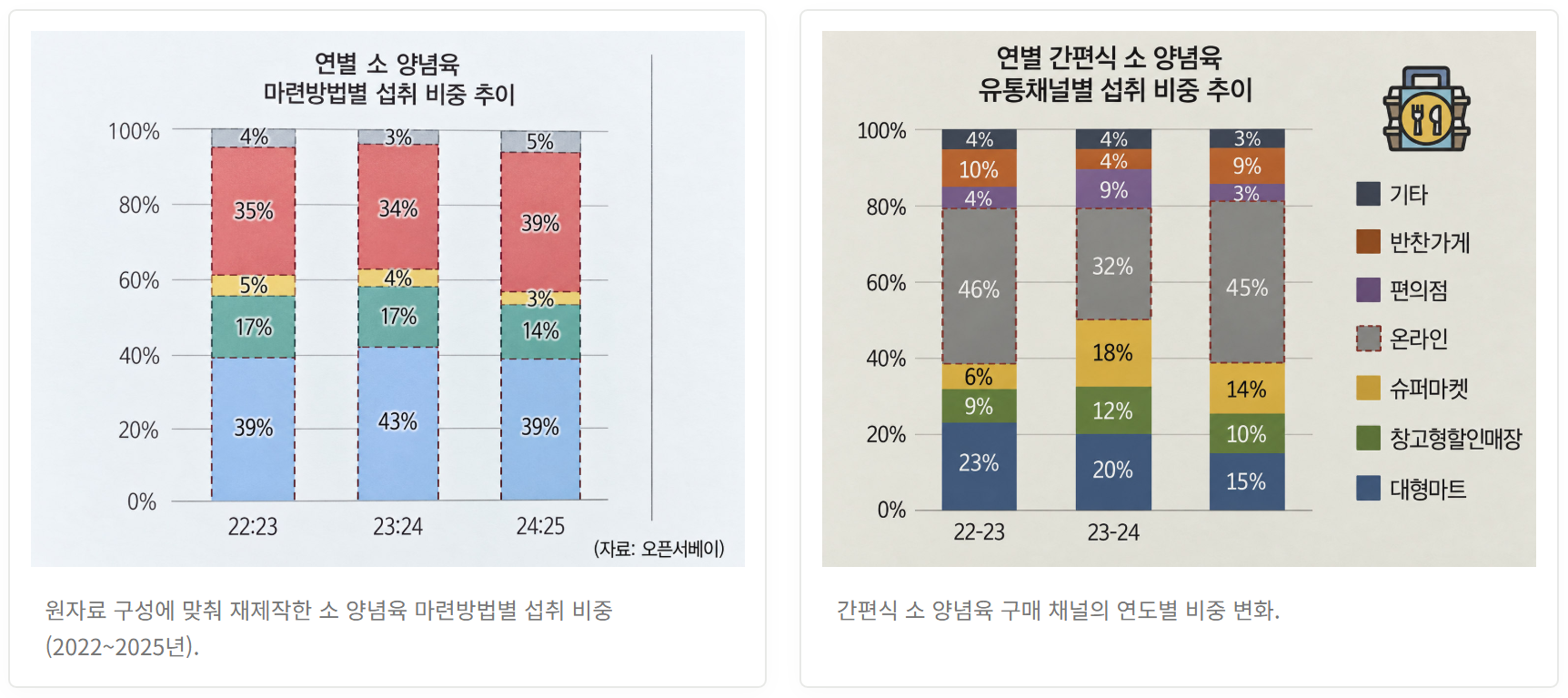
The shift in purchasing channels for ready-to-eat marinated beef is a point that the retail industry should pay particular attention to. Online purchases are projected to account for an overwhelming 45% of the market in 2024 and 2025. In contrast, hypermarkets have seen a decline for three consecutive years, falling from 23% to 20% to 15%. This was followed by warehouse-style discount stores (10%), supermarkets (14%), side dish shops (9%), and convenience stores (3%). It appears that the main battleground for ready-to-eat beef has completely shifted from offline shelves to online shopping carts.
Seasonality is also confirmed. While the consumption of marinated beef traditionally shows a pattern of high in autumn and winter and low in summer and spring, the curve for 2024 and 2025 moved at its lowest point among the three years. This means that even the power of the seasonal peak is not as strong as in previous years.
02
Menu Breakdown: Beef Bulgogi 'Dominates', Steak 'Plummets'
The picture becomes clearer when looking at what is eaten within marinated beef. The consumption share by specific menu item in 2024 and 2025 is 58.6% for beef bulgogi, 16.2% for steak, 14.6% for beef galbi, 4.7% for braised beef galbi, and 5.9% for others.
The three-year trend is interesting. Beef bulgogi firmly maintained the 60% mark, rising from 57.9% to 59.2% to 58.6%. Beef galbi (ribs) increased steadily from 11.6% to 13.4% to 14.6%, showing a steady growth in proportion despite the relatively low frequency of consumption. In contrast, steak contracted significantly compared to the first year, falling from 20.3% to 14.8% to 16.2%. Beef galbi jjim (braised short ribs) fluctuated around 5%, rising from 3.4% to 5.2% to 4.7%.
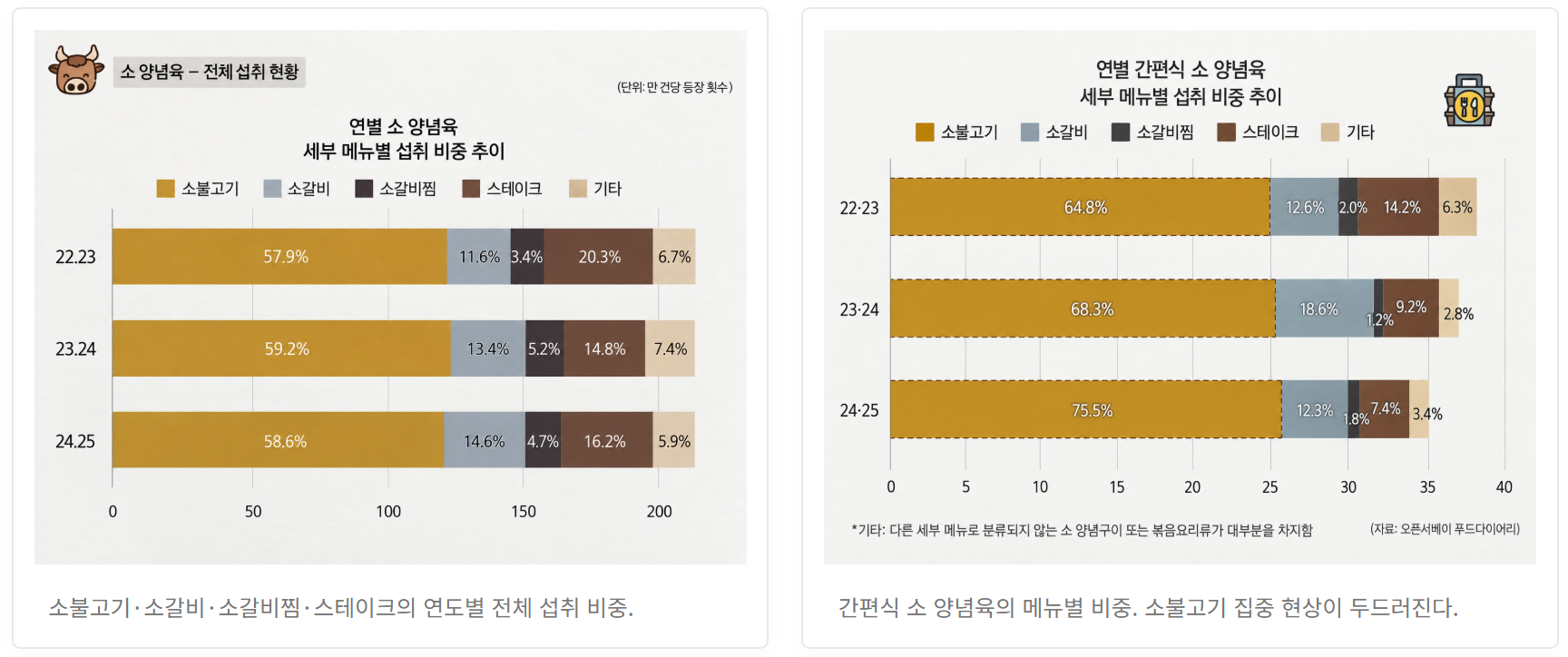
When looking solely at convenience foods, the trend is much more extreme. In 2024 and 2025, beef bulgogi accounted for 75.5% of marinated beef convenience foods. This is the result of a growing proportion each year, rising from 64.8% in 2022 and 2023 to 68.3% in 2023 and 2024. Convenience food beef galbi briefly rose from 12.6% to 18.6% to 12.3% before falling back down, while convenience food steak continued to decline from 14.2% to 9.2% to 7.4%. Convenience food braised beef galbi stood at 1.5%, a very low proportion due to the limited number of products released.
The authors interpret it as follows: as the overall consumption of marinated beef declines, consumer choices are increasingly shifting toward beef bulgogi, a traditional and familiar menu item. This represents a defensive consumption pattern where consumers converge on safer options as the overall market shrinks.
03
Beef Bulgogi: The Throne Was Saved, But the Kingdom Shrinks
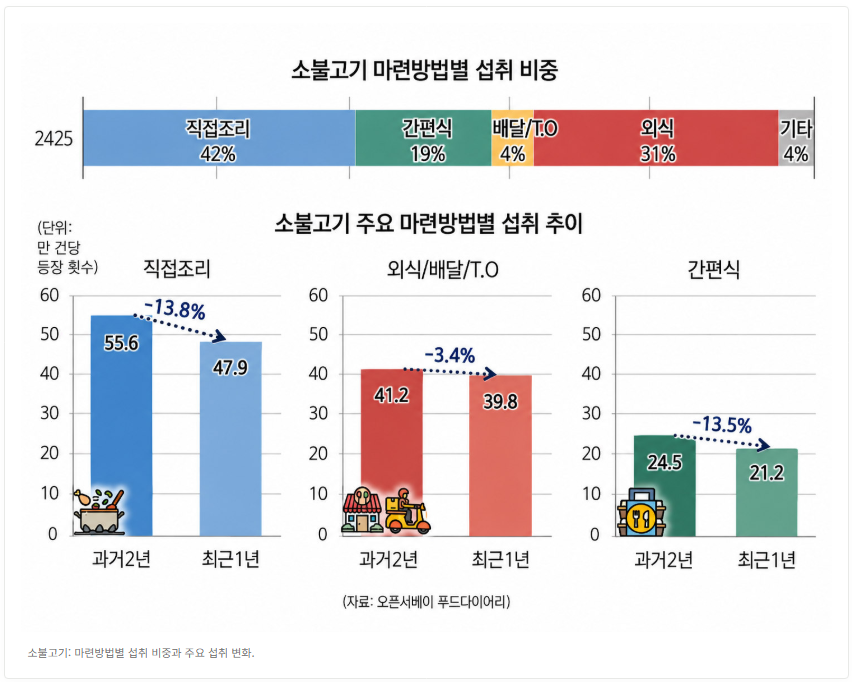
The total frequency of beef bulgogi consumption has decreased for three consecutive years, with the drop being particularly significant in 2024 and 2025 compared to 2023 and 2024. The preparation methods were home cooking 42%, dining out 31%, convenience food 19%, delivery/takeout 4%, and other 4%. While the 19% share of convenience food is relatively high compared to other marinated beef menu items, it must be noted that this is due to the sluggish performance of convenience foods for other menu items rather than beef bulgogi selling well.
Looking at the changes over the past year compared to the past two years, home cooking decreased from 55.6% to 47.9% (-13.8%), dining out, delivery, and takeout decreased from 41.2% to 39.8% (-3.4%), and convenience foods decreased from 24.5% to 21.2% (-13.5%). Although consumption decreased across all preparation methods, the decline in eating at home (home cooking and convenience foods) was about four times greater than that of eating out. The decline in beef bulgogi is a decline in 'home-cooked beef bulgogi'.
By segment, while consumption decreased in almost all combinations, the only exception was the increase in dining out, delivery, and takeout consumption among those in their 50s. Home-cooked beef bulgogi decreased across all segments over the past year, with the decline being particularly pronounced among women and those in their 50s. Convenience food beef bulgogi also declined across all segments, with those in their 40s showing a steady decrease for three consecutive years. This is a painful sign, given that those in their 40s were the core consumer group for convenience food beef bulgogi.
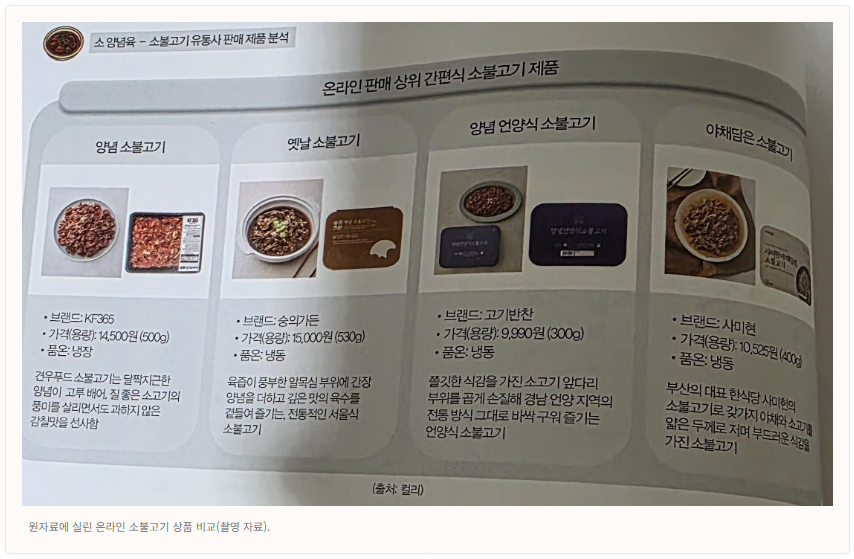
The top-selling ready-to-eat beef bulgogi products on the online channel Kurly include KF365 Seasoned Beef Bulgogi (500g, 14,500 won, refrigerated), Sungui Garden Old-fashioned Beef Bulgogi (530g, 15,000 won, frozen), Meat Side Dish Seasoned Unyang-style Beef Bulgogi (300g, 9,990 won, frozen), and Samihun Beef Bulgogi with Vegetables (400g, 10,525 won, frozen). Most of them share common characteristics such as being frozen, having a traditional soy sauce seasoning base, a small capacity for 2-3 servings, and a simple cooking method, while differentiating themselves through texture or ingredient composition (meat only vs. including vegetables).
04
Beef Ribs: The only growth menu item, but convenience food is -40%
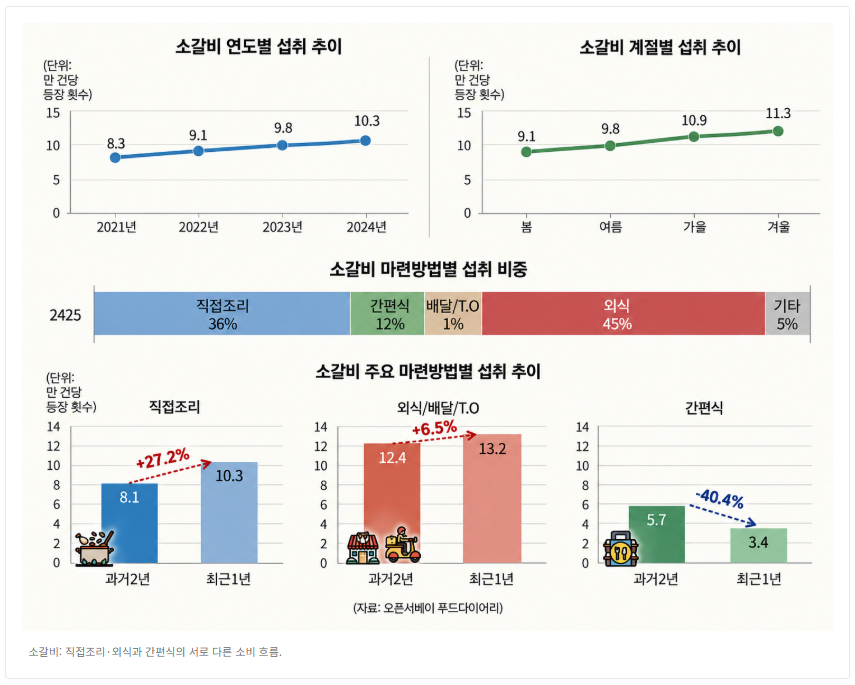
Among the four marinated beef menus, beef ribs (beef rib meat, bone-in ribs, LA ribs, etc.) were the only ones whose total consumption frequency increased for three consecutive years. The methods of preparation were dining out 45%, home cooking 36%, convenience food 12%, delivery/takeout 1%, and other 5%.
Looking at the changes over the past year compared to the past two years, home cooking increased from 8.1% to 10.3% (+27.2%), and dining out, delivery, and takeout increased from 12.4% to 13.2% (+6.5%), showing a clear upward trend. On the other hand, convenience foods plummeted from 5.7% to 3.4% (-40.4%). Convenience food consumption of beef ribs, which had increased in 2023 and 2024 compared to 2022 and 2023, has sharply declined again in the past year. This suggests that while people are eating more beef ribs, they are marinating them at home or grilling them at a restaurant rather than buying them as convenience foods.
Segment analysis reveals a dual structure in the beef rib market. While consumption of home-cooked beef ribs increased for both men and women over the past year, by age group, the core segment of those in their 30s and 40s decreased, while those in their 20s and 50s increased. For dining-out, delivery, and takeout beef ribs, consumption increased among men but decreased among women; those in their 20s saw a significant decline, while those in their 30s through 50s increased. Convenience food beef ribs decreased across all segments, and even the core consumer group in their 50s has been showing a downward trend for three consecutive years.
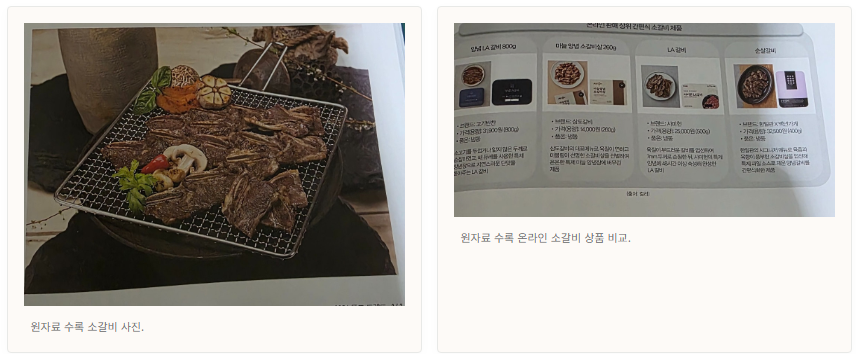
The top-selling ready-to-eat beef ribs on Kurly include Meat Banchan Seasoned LA Galbi (800g, 31,900 won), Samdo Galbi Garlic Seasoned Beef Ribs (260g, 14,000 won), Samihun LA Galbi (500g, 25,000 won), and Hanilgwan x Baeknyeongage Boneless Ribs (400g, 32,500 won), all of which are frozen products. They are meant to be grilled after thawing, and both LA Galbi and regular Galbi are among the top-selling items. A notable feature of the regular Galbi is the popularity of RMR (Restaurant Meal Replacement) products created in collaboration with famous restaurants.
05
Braised Short Ribs: A menu item that women eat out
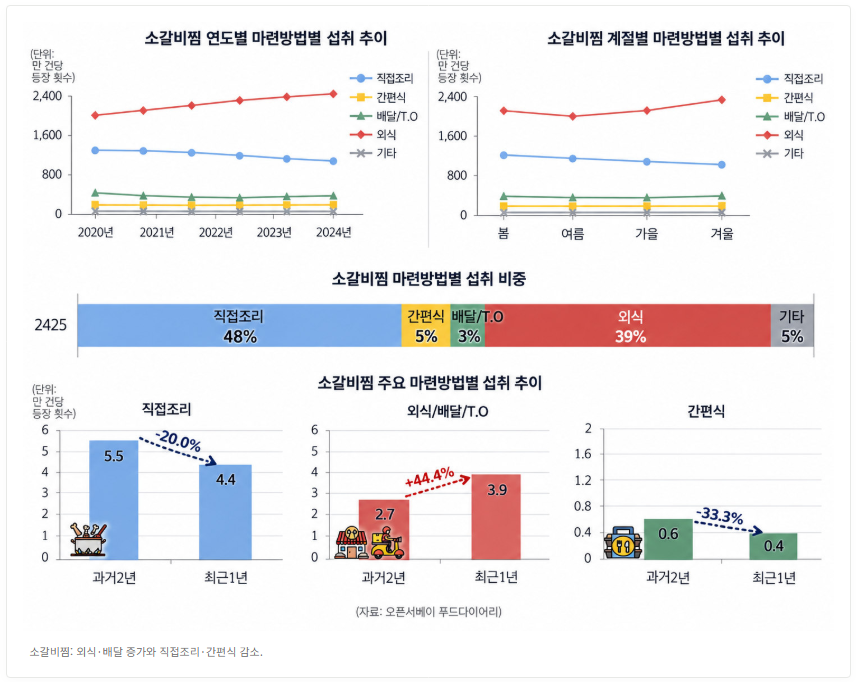
The total frequency of consumption for braised beef ribs increased in 2023 and 2024 compared to 2022 and 2023, but decreased slightly in the past year, while convenience foods have decreased for three consecutive years. Regarding preparation methods, home cooking accounts for an overwhelming 48% and dining out 39%, while convenience foods account for only 5%. Delivery/takeout is 3%, and other methods make up 5%.
The most notable change in preparation methods is the 44.4% increase (2.7% to 3.9%) for dining out, delivery, and takeout. Conversely, home cooking decreased from 5.5% to 4.4% (-20.0%), and convenience foods from 0.6% to 0.4% (-33.3%). Galbi-jjim is a labor-intensive dish traditionally eaten during holidays and banquets. The fact that this menu is rapidly shifting from the home to the outside demonstrates that the outsourcing of "laborious home cooking" is also taking place in beef dishes.
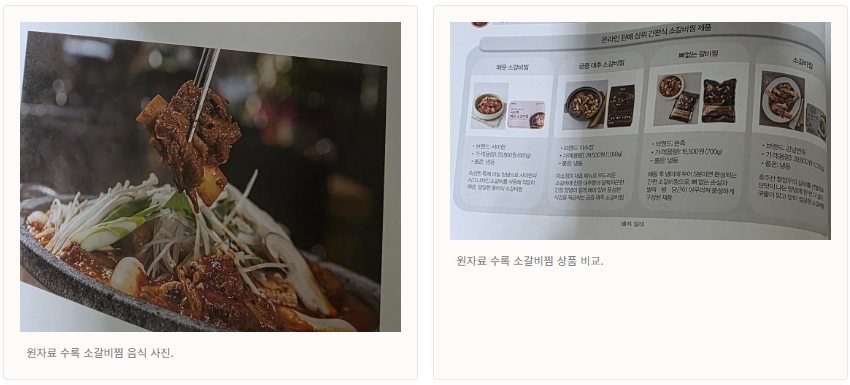
By segment, growth in dining out, delivery, and takeout centered on women, and growth in convenience foods centered on those in their 50s were observed. Home-cooked braised beef short ribs decreased across all segments over the past year, while dining out, delivery, and takeout saw an increase for women and a slight decrease for men. Although convenience foods account for a small share of the total, consumption among those in their 50s increased in 2023 and 2024 and has remained stable over the past year.
The top-selling ready-to-eat braised beef short ribs on Kurly are Samihun Spicy Braised Beef Short Ribs (820g, 29,800 won), Asojeong Royal Jujube Braised Beef Short Ribs (1,069g, 29,500 won), Bonjuk Boneless Braised Beef Short Ribs (700g, 19,500 won), and Gangnam Myeonok Braised Beef Short Ribs (1,000g, 29,800 won). All are frozen products that require boiling or heating after thawing. It is noteworthy that a product with a spicy seasoning, rather than traditional soy sauce seasoning, took first place, and that products with bones removed to enhance cooking and consumption convenience ranked highly. In essence, even braised short ribs are being reinterpreted with a focus on "spicy flavor" and "boneless meat."
06
Steak: I managed to eat out, but at home, it's cut in half.
In this analysis, steak was defined as meat for steak with added seasonings, and plain, unseasoned meat was excluded. The total frequency of consumption of seasoned steak decreased significantly in 2023 and 2024 compared to 2022 and 2023, and convenience food consumption decreased throughout the three years.
The most common method of preparation is dining out at an overwhelming 65%, followed by home cooking at 18%, convenience food at 7%, delivery/takeout at 3%, and other methods at 7%. Looking at the changes over the past year compared to the past two years, all preparation methods have decreased, but the differences in the magnitude of the decline are stark. While dining out, delivery, and takeout fared relatively well, falling from 22.2% to 21.3% (-4.1%), home cooking dropped from 9.0% to 5.8% (-35.6%) and convenience food from 4.3% to 2.1% (-51.2%), effectively disappearing by nearly half. These figures suggest that the "home steak" craze, which involved grilling steaks at home during the COVID-19 pandemic, has effectively come to an end.
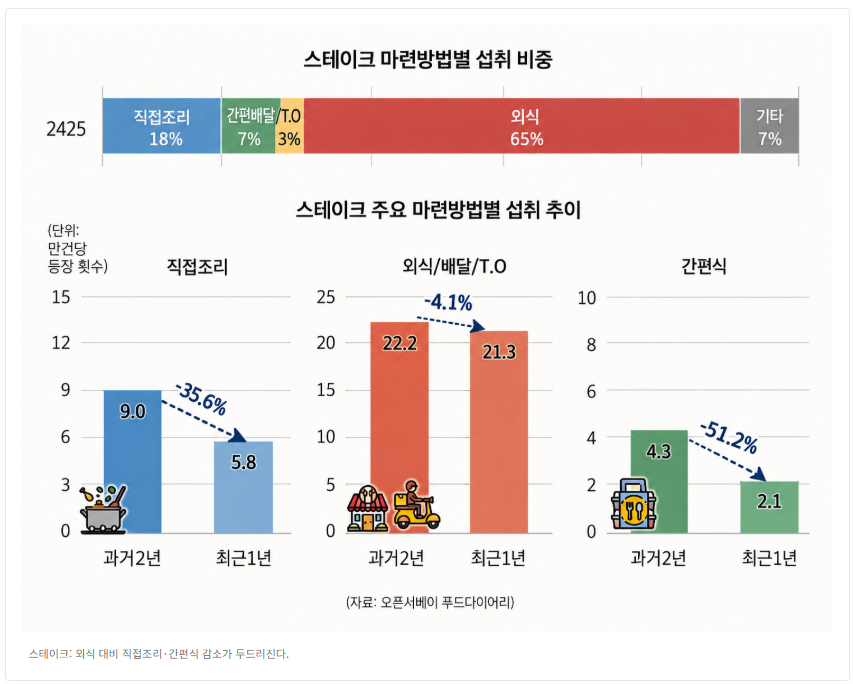
By segment, amidst an overall decline, consumption of dining out, delivery, and takeout increased over the past year, driven primarily by women and those in their 50s. Home-cooked steaks declined across all age groups, with the drop being particularly significant among women. Convenience food steaks not only have a small market size but have also been declining for three years, with consumption by those in their 40s—a key segment—also dropping significantly.
Kurly's top-selling ready-to-eat steaks are Taewoo Hanwoo Kosher Salt Steak (250g, 12,480 won, frozen), Meat Enjoy Seasoning Tenderloin Steak (150g, 13,000 won, chilled), Meat Enjoy Seasoning Chuck Eye Roll Steak (180g, 9,900 won, chilled), and Meat Enjoy Seasoning Flank Steak (180g, 9,900 won, chilled). Most are chilled, single-serving portions, and thickly cut, with seasoning added beforehand so they can be grilled and eaten immediately. There appears to be an attempt to differentiate the meat quality and texture by using specific cuts such as tenderloin, flank, and chuck eye roll, while maintaining basic seasonings centered on salt and pepper. Given the small portion size of 150 to 250g and a price range of around 10,000 won, the product design targets the "solo dining steak" market.
DATA READING
Summary: Five Signals from the Seasoned Beef Market
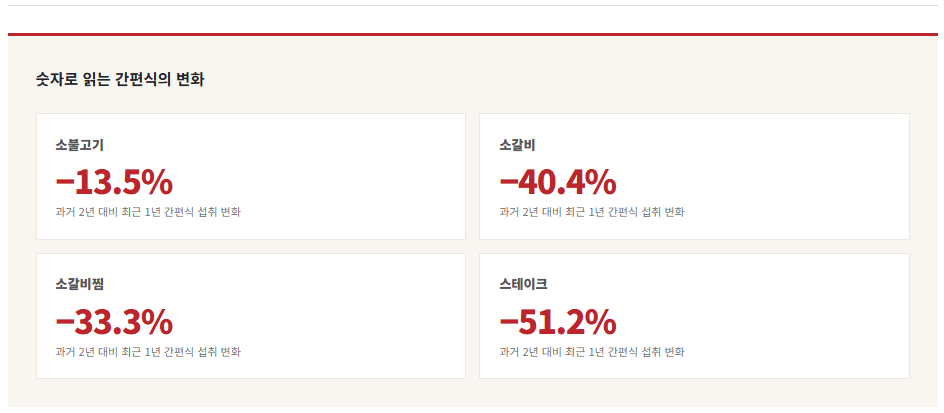
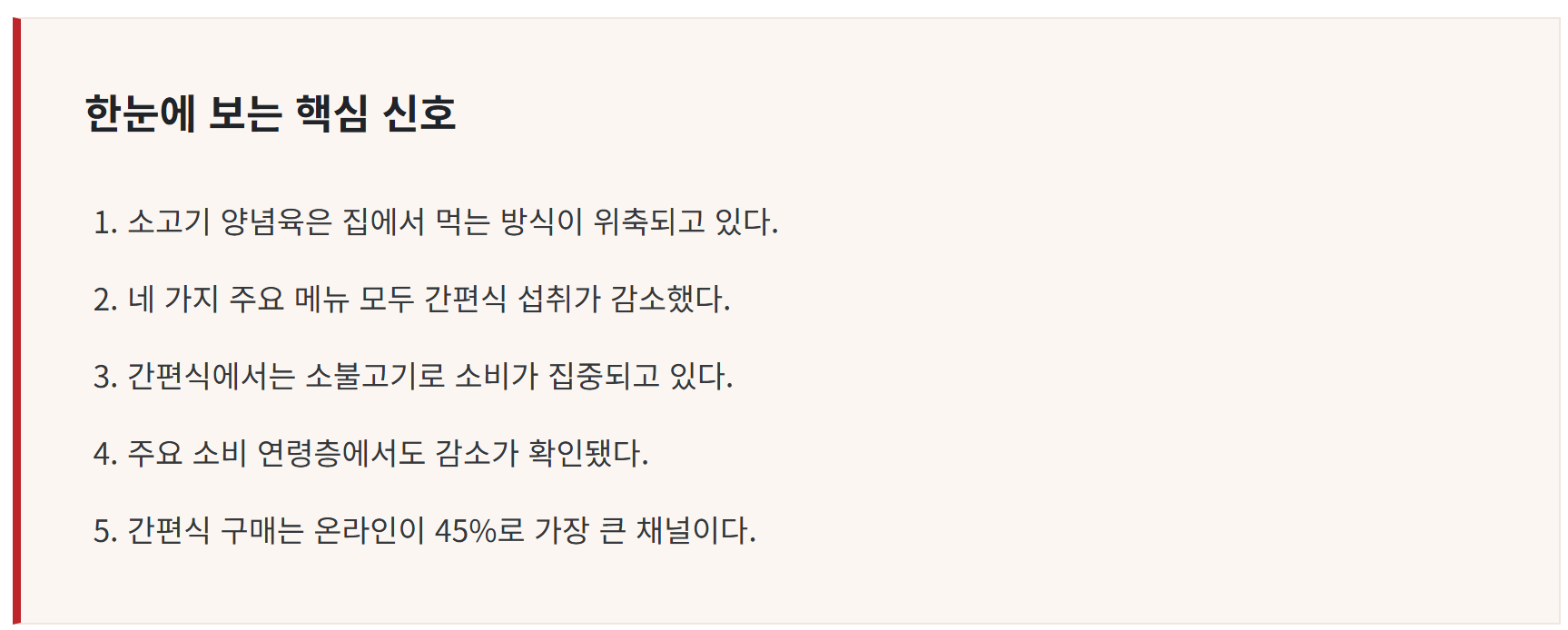
The signals sent by three years of data can be summarized as follows.
First, beef is losing ground at home. Home cooking has decreased significantly for beef bulgogi (-13.8%), braised beef short ribs (-20.0%), and steak (-35.6%). The only exception is home cooking of beef short ribs (+27.2%). On the other hand, dining out, delivery, and takeout increased for beef short ribs (+6.5%) and braised beef short ribs (+44.4%), while the decline was small for beef bulgogi (-3.4%) and steak (-4.1%). Beef is returning to being a food eaten outside on special occasions.
Second, convenience beef has fallen into a structural slump. Beef short ribs -40.4%, braised beef short ribs -33.3%, steak -51.2%, and beef bulgogi -13.5%. Convenience food sales decreased for all four menus, and three menus have declined for three consecutive years. This is the reason why the authors noted that it was difficult to find growth menus for marinated beef.
Third, what survives is the 'familiar.' Beef bulgogi accounts for 75.5% of ready-to-eat marinated beef. When the market shrinks, consumers return to proven flavors rather than experimentation.
Fourth, core segments are leaving. The key consumer bases for each menu item—such as those in their 40s for ready-to-eat beef bulgogi, 50s for ready-to-eat beef galbi, and 40s for ready-to-eat steak—have reduced their consumption for three consecutive years. It is a structure where existing customers are leaving without an influx of new customers.
Fifth, online is the only growth channel. The proportion of online purchases for ready-to-eat marinated beef has dropped to 45%, compared to 15% at large supermarkets. The starting point for product development should be the search bar of Kurly or Coupang, not the supermarket shelves.
INDUSTRY OUTLOOK
Implications for the industry
The message this chapter delivers to developers of beef convenience foods is stark. In a phase where the entire marinated beef category is contracting, it is difficult to grow by making 'better beef bulgogi' alone. However, there are niches scattered throughout the data.
The rapid growth of dining out and delivery of braised beef short ribs (+44.4%), along with the rise of boneless and spicy products, suggests the potential to redefine braised short ribs not as a 'holiday food' but as an 'everyday meal ordered for delivery.'
The popularity of beef short ribs in RMR is proof that collaborative products featuring famous rib restaurant brands are still effective.
Single-serving refrigerated seasoned steaks maintained their top rankings despite the sharp decline of convenience steaks. The era of 'large meat' for home steaks is over, but 'solo dining steak' remains.
The increase in beef bulgogi and braised beef ribs for dining out and delivery among people in their 50s suggests that the senior delivery market could be the final growth axis for beef menus.
Above all, the direction emphasized by the authors is "convenience meat rice bowls." They argue that if a product is introduced that combines rice and seasoned meat but is presented at a different temperature and in a different form than existing room-temperature cup rice, it could create new demand even in the shrinking seasoned beef market. If spicy pork and chicken are already heading in that direction, beef simply has not yet found its answer.

- #축산물
- #유통
Related Content

Meat Culture & Trends
“Dawn of the Era of Hansik 3.0”… The 1st Hansik Day Declares a New Future for K-Food
At the 1st Korean Food Day ceremony in 2026, the government announced the ‘Korean Food 3.0’ vision. At the Korean Food Conference, Bibigo’s global strategy and chefs’ plans for the globalization of Korean food were discussed.
2026.10.26
Meat Culture & Trends
Did plant-based meat really replace meat? ... 96% of purchasing households also bought meat.
Is plant-based meat substitute truly replacing meat as its name suggests? Actual purchasing data from U.S. consumers indicates that the majority of purchases involve buying animal-based meat along with plant-based alternatives.
농촌경제연구원 · 2026