
Global Field Report
U.S. Expands Import Channels for Live Cattle from Mexico… Phased Reopening of 4 Border Quarantine Facilities
Following Douglas and Santa Teresa, Columbus is scheduled to open on the 26th... Nogales pushes for conditional reopening in late November.
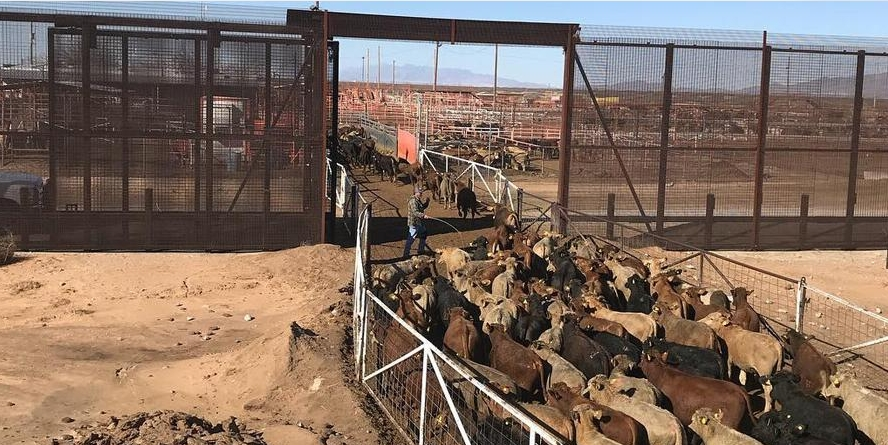
The United States is accelerating the normalization of livestock trade by successively reopening border quarantine facilities for the import of live cattle from Mexico. This approach involves gradually expanding import channels while maintaining the disease control system to prevent the introduction of New World Screwworm (NWS).
The U.S. Department of Agriculture (USDA) Animal and Plant Health Inspection Service (APHIS) in New MexicoColumbus border quarantine facilities open from October 26They announced a schedule to do so. This is the third measure following the reopening of Douglas, Arizona on August 24 and Santa Teresa, New Mexico on September 24.
APHIS plans to open Nogales, Arizona, on November 30 as well. However, Nogales must meet necessary conditions, such as disease prevention measures and facility readiness.
Phased resumption starting in August… Expansion of import channels to four planned
Under this plan, the number of quarantine facilities through which Mexican cattle can enter the United States will be increased in stages. The facilities to be opened are two in Arizona and two in New Mexico, all located on the southwestern U.S.-Mexico border.
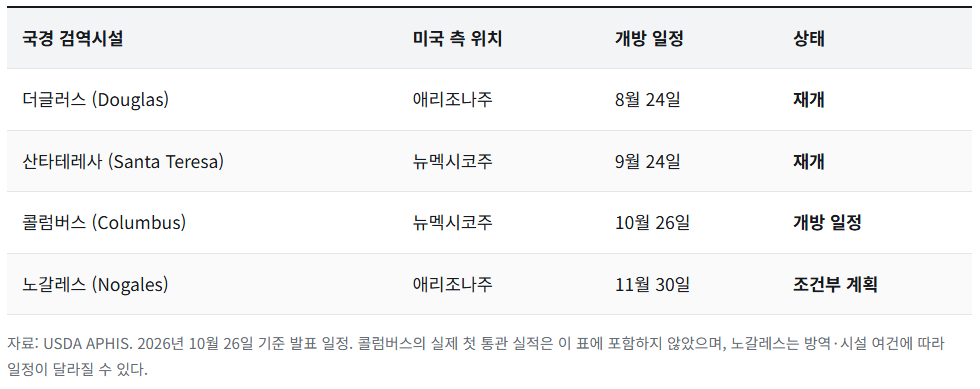
The USDA is proceeding with the reopening of quarantine facilities based on enhanced disease control measures against novel nematode disease and assessments of livestock hygiene. Decisions regarding additional reopenings are also made by considering disease control conditions and the operational readiness of the facilities.
Two facilities already open received approximately 9,500 heads during their first week of full operation
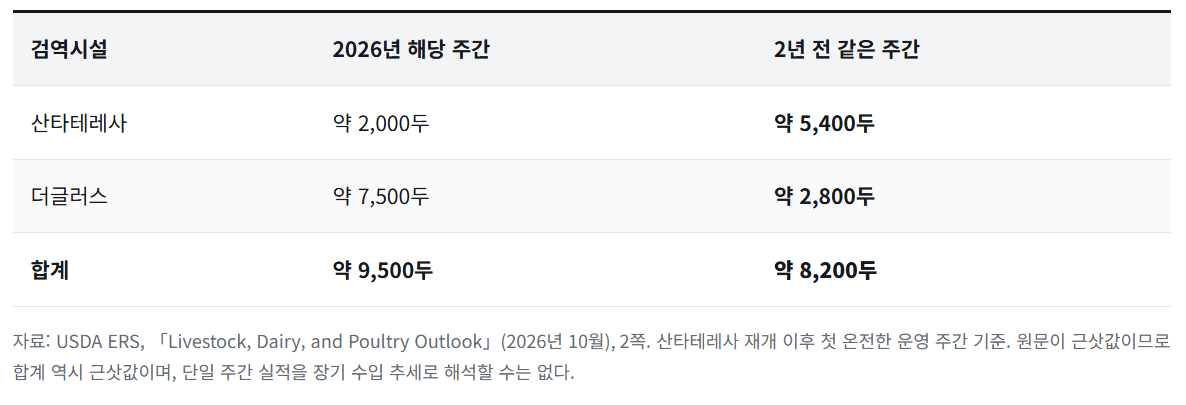
The actual import of cattle from Mexico has also been confirmed since the reopening of quarantine facilities. According to the USDA Economic Research Service (ERS) Livestock Outlook report dated October 16, during the first week of full operation following the reopening of Santa Teresa...Santa Teresa approximately 2,000 heads, Douglas approximately 7,500 headswas brought in.
The two facilities combined total about 9,500 head. During the same week two years ago, about 5,400 head were imported from Santa Teresa and about 2,800 from Douglas, showing a difference in the proportion of volume by facility.
Even with increased import channels, the U.S. beef supply shortage persists
Expanding imports of live cattle from Mexico is a measure that can supplement the supply of fattening cattle in the United States. However, the USDA’s October outlook shows that domestic cattle supply conditions remain tight.
USDA ERS projected U.S. beef production in 202724.675 billion pounds (approx. 11.19 million tons)This forecast is 160 million pounds (approximately 73,000 tons) lower than the previous month's forecast. This reflects the shortage of cattle supply in the U.S., a decrease in feedlot entry, and a slowdown in the speed of slaughter.
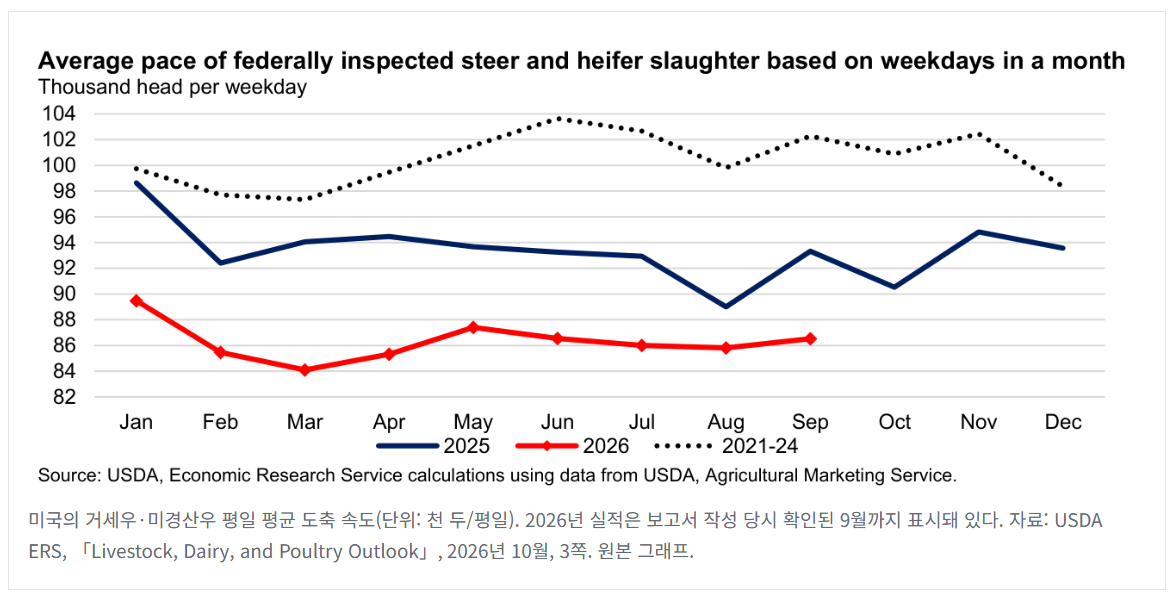
The slaughter trend graph in the report also shows that the average number of castrated and heifer slaughtered on weekdays in 2026 will be lower than the averages of 2025 and 2021–2024.

Ultimately, this expansion of border quarantine facilities is significant in that it restores the import channel for live cattle from Mexico. However, how many cattle are actually brought in through these additional facilities, and to what extent this will affect feedlot placement and beef production within the U.S., will need to be confirmed through subsequent USDA performance and forecast reports.
Original source
①USDA APHIS Announces Phased Reopening of Southern Border Quarantine Facilities
②USDA ERS, Livestock, Dairy, and Poultry Outlook: October 2026 (LDP-M-388)
- #수입육
Related Content
Global Field Report
South American Beef Makes a Strong Presence… Meat Export Competition at SIAL Paris 2026
South American beef companies stood out in the meat section of SIAL Paris 2026, where the global food industry gathered.
2026.11.1

Global Field Report
China's Muyuan Invests Approx. 190 Billion Won in Vietnam... Sets Out to Establish 2 Million Head Production System
China's major pig farming company Muyuan is investing approximately $140 million to build a large-scale pig farm and feed factory in Vietnam.
2026.10.19
Global Field Report
Danish Crown Reorganizes Business Centered on European Market… Aims for 50% High Value-Added Meat Sales by 2030
Danish Crown announced a reorganization plan on October 2 and stated that it would increase the proportion of high value-added meat supplied by member farms from the current approximately 25% to 50% by the end of 2030. To achieve this, seven of the existing eight business divisions will be integrated into a single organization.
2026.10.13