
SPECIAL FOCUS
Chicken Supply Rises, But Cuts Are Short… Mixed Supply and Demand Battle Amidst November Price Drop
KREI forecasts November slaughter volume to rise by around 6.6% and live meat price at 1,500 won per kg
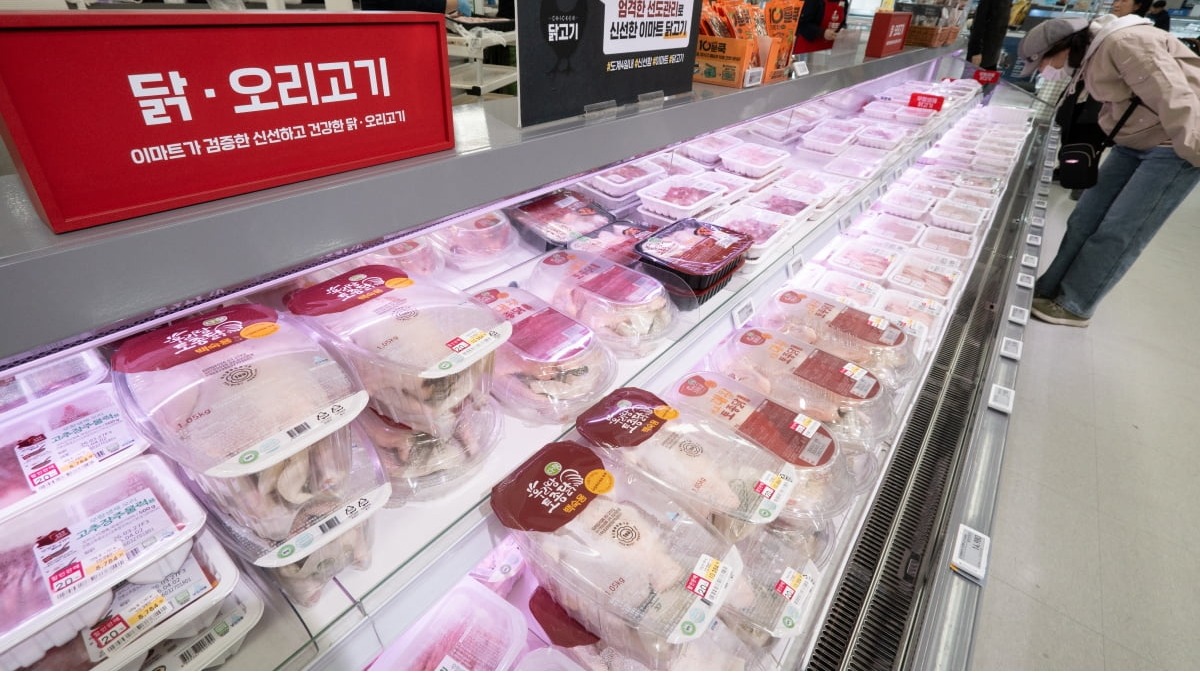

The broiler market in November is expected to face increasing downward price pressure due to a rise in slaughter volume. However, it is difficult to conclude that the overall supply and demand balance in the chicken market has become sufficient based solely on the increase in supply. Although the number of slaughtered chickens increased in October as well, live chicken distribution prices remained higher than last year due to a shortage of cut meat inventory. In terms of home consumption, sales of whole chickens have decreased while sales of cut meat have increased, indicating that the overall supply volume and demand by product are showing divergent trends.
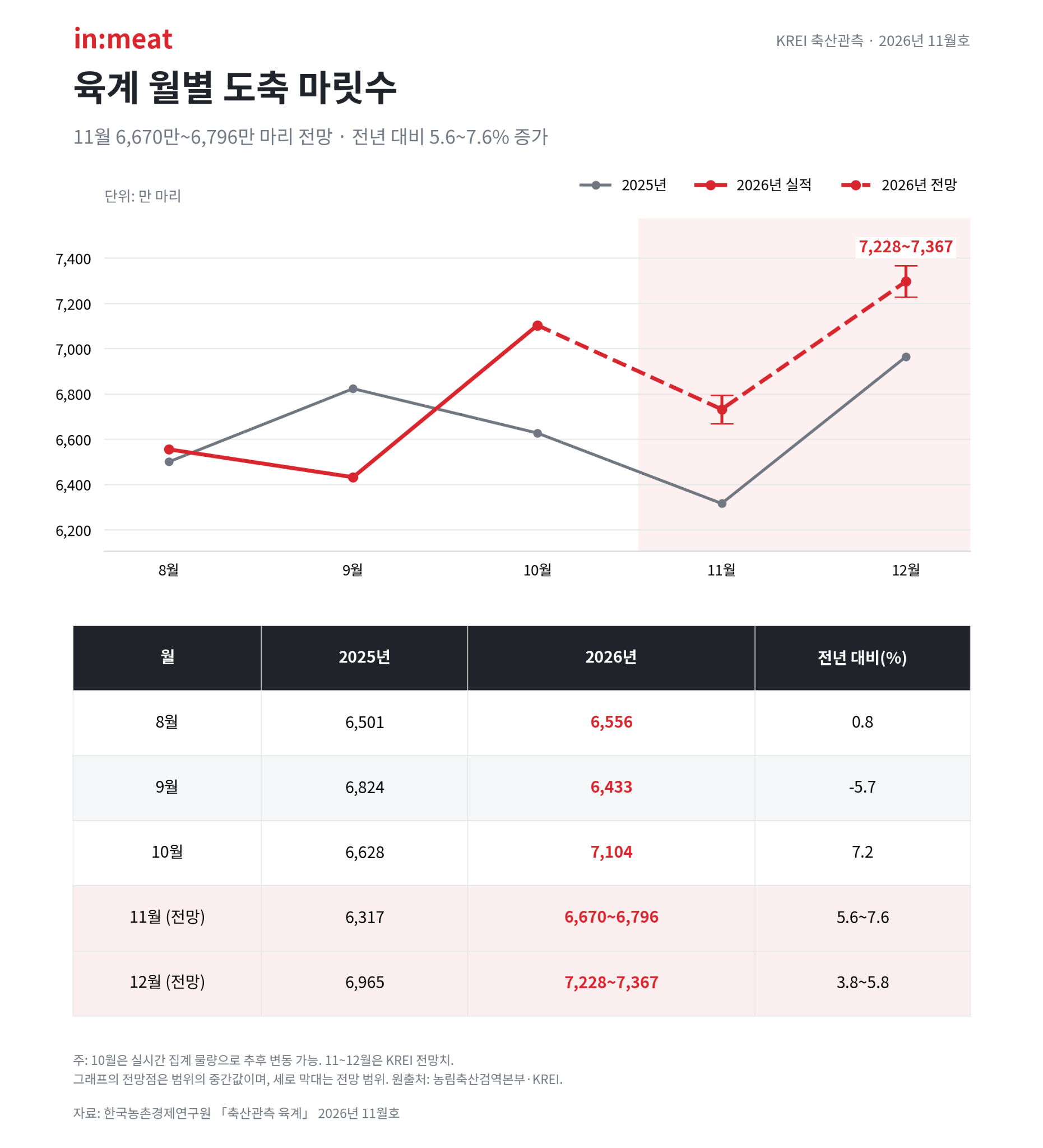
According to the ‘Livestock Outlook: Broiler November Issue’ published by the Korea Rural Economic Institute (KREI) on November 3, the number of broiler chickens slaughtered in November is projected to be between 66.7 million and 67.96 million, an increase of 5.6% to 7.6% compared to the same month last year. The institute suggested an increase of around 6.6%.
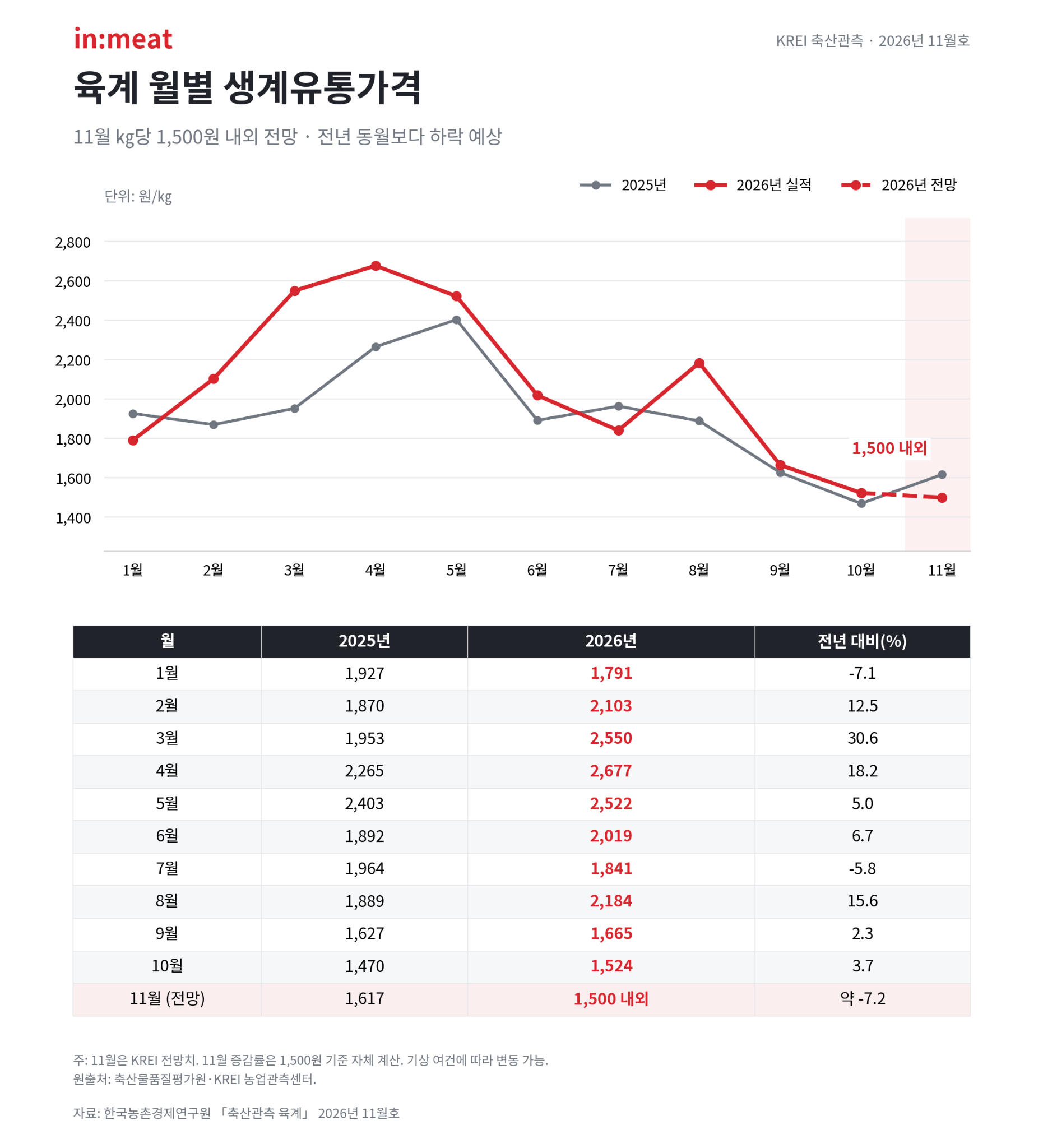
Accordingly, the distribution price of livestock in November is expected to be around 1,500 won per kilogram. This is about 7.2% lower than 1,617 won in the same month last year and about 1.6% lower than 1,524 won in October of this year. If the current forecast holds true, the price adjustment will be more pronounced when compared to the same month of the previous year than to the previous month.
Productivity improvements support supply expansion; December expected to exceed last year's levels as well.
Changes in working days and productivity are underlying the increase in slaughter. The number of broiler chickens slaughtered in October was 71.04 million, a 7.2% increase from last year. Researchers cited the increase in working days and improvements in broiler productivity as major factors.
These changes were also confirmed in a survey of sample farms. The shipping weight in September and October was 1.69 kg, an increase of 1.0% compared to the previous year, while the feed requirement was 1.43 kg, a decrease of 1.8%. The rearing period shortened from 32.3 days last year to 32.0 days this year. With the rearing period slightly reduced, shipping weight increased and feed efficiency improved.
This demonstrates that when assessing supply conditions, both the number of slaughtered animals and their shipping weights must be considered. This is because even if the same number of animals are slaughtered, the amount of meat produced can vary depending on the weight per animal. However, since this data does not present monthly chicken production weights, the growth rate of slaughtered animals cannot be directly interpreted as the growth rate of production volume.
The trend of expanding supply is expected to continue in December. The number of slaughtered animals in December is projected to be between 72.28 million and 73.67 million, an increase of 3.8% to 5.8% compared to last year. With the number of chicks introduced in November also expected to increase by approximately 4.3% year-on-year to between 74.29 million and 75.72 million, it appears that the expansion of the production base will continue for the time being.
Prices to rise in October even with increased slaughter; cut meat inventory is a variable
However, an increase in slaughter does not immediately lead to a drop in prices. The distribution price of live animals in October was 1,524 won per kilogram, a 3.7% increase from the same month last year. Even as the number of slaughtered animals increased by 7.2%, prices remained above last year's levels.
The researchers explained the shortage of cut meat inventory as the background. Monitoring surveys also showed that the inventory of cut meat remained lower than last year.
This trend demonstrates that the supply and demand of the broiler market cannot be explained solely by the total number of chickens. While the volume of each specific cut produced from a single chicken is limited, consumption can be concentrated on particular parts. This means that even if the total slaughter volume increases, the supply situation perceived by the market may differ if sufficient inventory of the cuts in high demand is not secured.
The price outlook for November also reflects both of these factors. Researchers predicted that while there is a shortage of cut meat inventory, an increase in the number of slaughtered animals will act to lower prices. To assess future price trends, it is necessary to check not only slaughter performance but also how much cut meat inventory recovers.
Changes in consumption, such as a decrease in whole chicken sales and an increase in chicken parts, are also noteworthy in home sales.
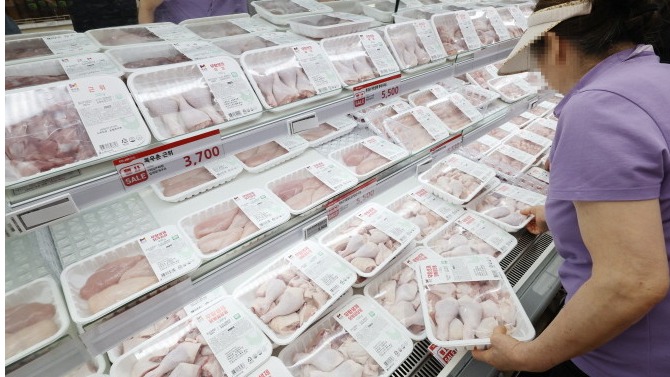
There were also distinct differences in consumption by product type. In September, household chicken sales decreased by 12.2% compared to the same month of the previous year. However, specifically, sales of whole chicken products, including whole chickens and cut meat, fell by 18.9%, while sales of chicken parts increased by 9.8%.
A decrease in overall sales volume and an increase in sales of specific cuts occurred simultaneously. This indicates that rather than classifying chicken consumption as simply increasing or decreasing, one must examine which specific products are selling. When considering the increase in sales of specific cuts alongside inventory shortages, it is possible that differences in demand by product are influencing supply and demand.
However, it cannot be concluded that overall chicken demand, including dining out, delivery, and school meals, has contracted based solely on in-home sales. It is also difficult to pinpoint the cause of the increase in sales of chicken parts based on this data alone. Further analysis of sales trends and verification of distribution channels are necessary to determine whether these consumption changes will be sustained.
Will the decline in livestock prices resulting from the expansion of domestic slaughtering amidst declining imports lead to lower consumer prices?
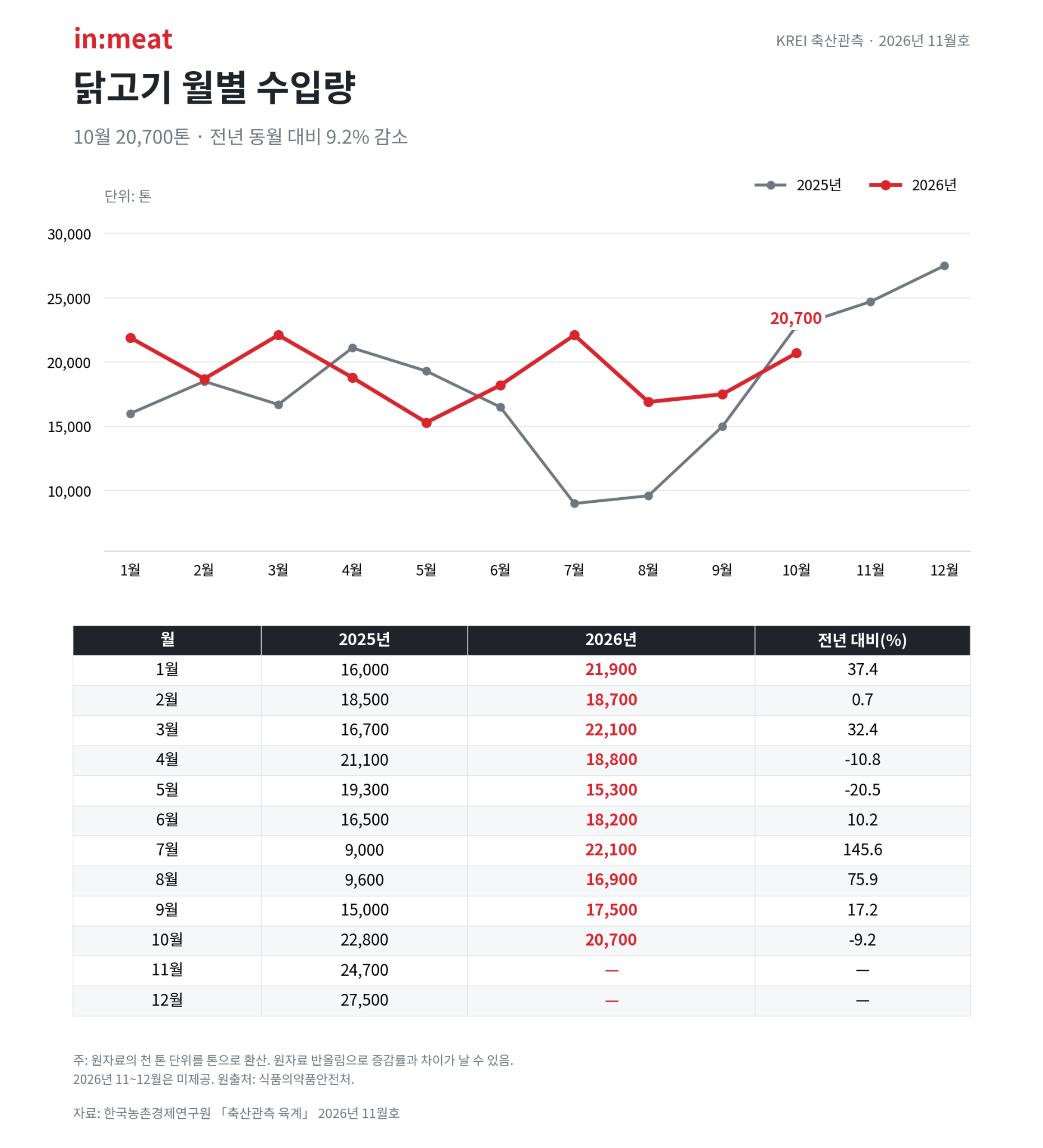
Imports moved in the opposite direction to domestic slaughter. Chicken imports in October totaled 20,700 tons, a 9.2% decrease from the same month last year. The import unit price rose 2.4% to $2.51 per kilogram.
Given that an increase in domestic slaughter and a decrease in imports occurred simultaneously, it is necessary to distinguish this from a phase of supply expansion where both domestic production and imports are rising. However, since domestic and imported products may differ in their distribution patterns and uses, this data does not confirm to what extent the decrease in imports has been replaced by domestic products.
Caution is also required when interpreting the outlook for live distribution prices in the same way as the outlook for consumer prices. In October, the consumer price index for chicken rose 1.8% year-on-year, and the consumer price index for fried chicken rose 2.0%. Although live distribution prices were also higher than the previous year in the same month, it is not possible to determine the extent to which prices at each stage are linked based solely on these indicators.
Even if live chicken distribution prices fall in November, the extent and timing of their reflection in retail and restaurant chicken prices must be verified separately. This is because they pass through the slaughter, processing, and distribution processes, as well as the cost structure of restaurant businesses.
Ultimately, the key to the broiler market in November and December lies in how much the increasing volume of slaughtered chickens can resolve the shortage of chicken cuts. While the researchers forecasted a price decline due to increased supply, they also noted the possibility of fluctuations depending on weather conditions. They also urged thorough disease control measures to prepare for highly pathogenic avian influenza (HPAI).
dataKorea Rural Economic Institute, "Livestock Outlook: Broiler Chickens," November 2026 issue (published November 3).
Statistical image: in:meat reconstructed. November–December outlooks were separated from the actual performance of the respective months, and some price comparison rates were calculated using the presented figures.
- #축산물
- #유통
Related Content
SPECIAL FOCUS
U.S. Government to Purchase $41 Million in Pork… Supporting Market Stabilization for Agricultural, Livestock, and Fisheries Products
The U.S. Department of Agriculture (USDA) announced a plan to purchase agricultural and fishery products worth a total of $472.5 million, including $41 million in pork and $20 million in chicken.
2026.11.1

SPECIAL FOCUS
Pork trotters restaurants have changed, but the raw material market remains the same… What is the way out for domestic pork trotters?
The fact that domestic pig's trotters are not selling does not mean that consumption of pig's trotters has disappeared. The issue lies in how well the market supplying the raw materials has kept pace with the changes in how consumers select and order pig's trotters.
2026.10.29

SPECIAL FOCUS
Coupang Directly Sources Beef from Nebraska, U.S.… A New Variable in Imported Meat Distribution Competition
Coupang announced on October 27 that it is launching its first direct sourcing program for U.S. beef in partnership with Nebraska Beef, based in Omaha, Nebraska.
2026.10.28