
SPECIAL FOCUS
Coupang Directly Sources Beef from Nebraska, U.S.… A New Variable in Imported Meat Distribution Competition
Launch of Nebraska Beef and First U.S. Beef Direct Procurement Program
Coupang is partnering with a beef processing company in Nebraska to directly procure U.S. beef. The plan is to expand sales channels for U.S. producers by connecting Korea's high demand with its own logistics network. Amid supply constraints and price burdens for U.S. beef, attention is focused on how a major online retailer's strengthened local sourcing will change competition in the domestic imported meat distribution market.
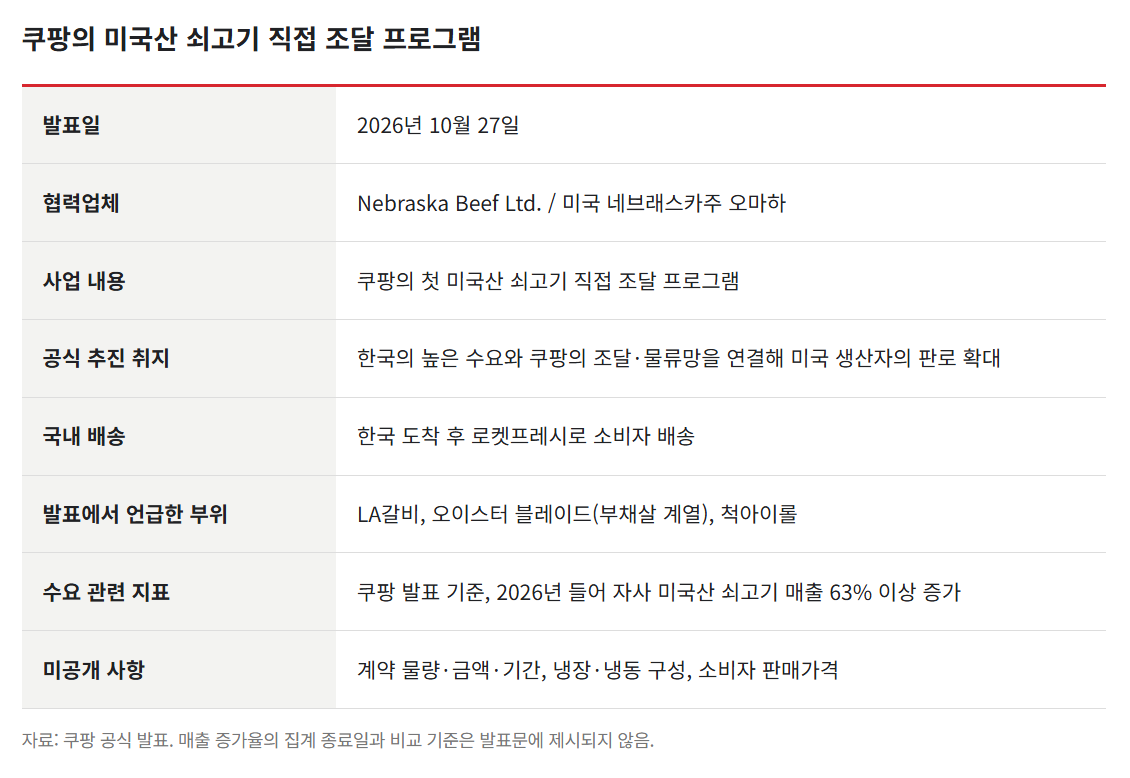
Coupang announced on October 27 that it is launching its first direct sourcing program for U.S. beef in partnership with Nebraska Beef, based in Omaha, Nebraska. The locally sourced beef is brought into Korea via Coupang's logistics network and delivered to consumers through Rocket Fresh.

Connecting Korea's High Demand with U.S. Producers
The business background officially emphasized by Coupang is the demand in the Korean market and the procurement and logistics capabilities to connect it. According to the company, sales of U.S. beef on Coupang have increased by more than 63% this year. However, the announcement did not provide specific end dates for the aggregation or comparison criteria.
Robert Porter, Coupang's Chief Global Officer (CGAO), explained that this program will serve as an opportunity to help Nebraska producers access overseas markets and create new revenue streams. Coupang also highlighted its ability to efficiently supply time-sensitive meat by utilizing its own logistics network.
In particular, mentioning LA galbi, flank steak, and chuck eye roll, the report emphasized sales opportunities for cuts preferred in Asia. It explained that producers can increase the market value of beef by leveraging overseas demand for specific cuts.
The contract volume, amount, duration, refrigerated and frozen product composition, and consumer sales prices were not disclosed. No specific cost reduction effects or price reduction plans resulting from direct procurement were presented either.
The partner company is a beef slaughterhouse and processing plant located in Omaha.
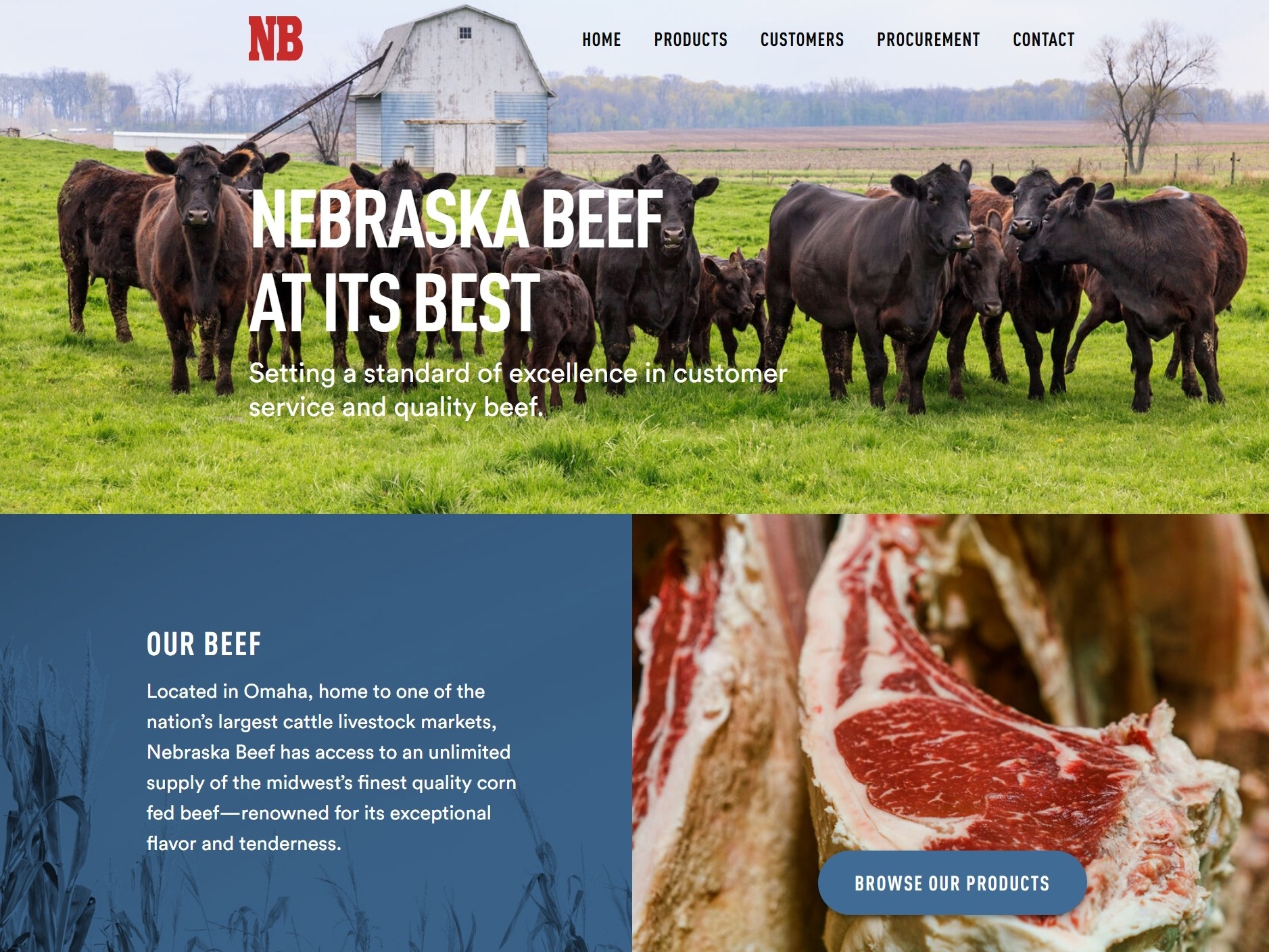
Nebraska Beef Ltd. is a beef slaughter and processing company based in Omaha, Nebraska, USA. According to its official website, it sources cattle in cooperation with local farms and fattening companies, and most of the cattle supplied are raised within a 250-mile (approximately 402 km) radius of the Omaha plant.
It operates a 212,000-square-foot (approximately 19,695 m²) facility at a single site in Omaha. It supplies USDA Prime, Choice, and Select beef, as well as products trimmed to customer requirements, to retailers, large membership distributors, wholesalers, and restaurants. The company states that it is qualified to export to more than 25 countries, including Korea, Japan, Canada, and Mexico.
The National Cattle Association of America (NCBA)’s *Directions 2025* lists the company as having a daily slaughtering capacity of 2,500 head. This is processing capacity distinct from actual slaughter performance. The data does not provide revenue or the actual annual number of slaughtered head.
This collaboration is a structure that connects production bases with the Korean consumer market through these processors. The announcement does not confirm whether there are direct contracts between individual farms and Coupang, nor does it imply that the export of Nebraska beef to Korea has been permitted for the first time.
Market Background of Direct Procurement: US Production Pharmaceuticals and Price Burdens
Coupang did not directly cite supply instability of U.S. beef as the reason for this business move. However, U.S. production constraints and the outlook for rising average annual prices are important market factors surrounding this move.
According to the National Agricultural Statistics Service (NASS) under the U.S. Department of Agriculture, the number of beef cows in the United States stood at 28.5 million as of July 1 this year, a 1% decrease from the previous year. Calf production this year is also projected to fall by 2% from the previous year to 32.5 million. These are indicators showing that there remains a burden on the breeding base and the supply of calves needed to support future shipments.
In its October outlook, the U.S. Department of Agriculture Economic Research Service (ERS) predicted that slow slaughter trends would continue until 2027 and slightly lowered its forecast for beef production this year and next year compared to the previous month.
In its separate food price outlook, the ERS projected that U.S. beef wholesale prices would rise by an annual average of 8.8% this year. However, monthly trends differ. While wholesale prices in September rose 2.6% from the previous month, they were 3.6% lower than the same month last year. The forecast of an annual average increase should not be interpreted to mean that prices have consistently risen recently. This indicator represents domestic wholesale prices in the U.S. and is distinct from the rate of increase in import prices in Korea.
According to the U.S. Meat Export Federation (USMEF), U.S. beef exports to South Korea from January to August this year totaled 149,092 tons, an 8% decrease from the previous year; however, export value fell by only 3% to $1.51 billion. As the decline in value was smaller than the decline in volume, the average export unit price has shown an upward trend. However, the average unit price is also influenced by the composition of cuts and grades.
It is difficult to explain the decline in exports to Korea solely due to U.S. supply constraints. The USMEF explained that the fact that Korean importers stockpiled frozen meat ahead of the activation of safeguards on Australian beef also affected the market this year. Looking at August alone, U.S. beef exports to Korea rebounded, with volume increasing by 14% and value by 20% compared to the same month last year.
Under these circumstances, Coupang's local cooperation can be interpreted as a move to strengthen supply relationships to support increased sales demand. However, it cannot be confirmed solely from publicly available data whether supply instability is the direct reason for this initiative or what effect the contracts will have on securing inventory volume.
Competing with hypermarkets, moving beyond sales prices to the procurement stage
Domestic large supermarkets have already established and are operating purchasing, processing, and sales networks. E-Mart has been connecting products processed at its own meat center with online sales. SSG.com announced in 2020 that it would introduce Hanwoo and Handon products from its meat center via early morning delivery. On the Australian Wagome Wagyu products sold at Lotte Mart Zeta, Lotte Trading is listed as the producer and importer.
Given these existing business structures, this move can be seen as an opportunity for the scope of competition between retailers with overseas procurement networks and Coupang, which possesses online sales capabilities, to overlap even further. Large supermarkets are likely to respond by reviewing purchasing conditions with suppliers, adjusting origins, grades, and product assortments, or strengthening the price competitiveness of their flagship items. However, this is an analysis of future responses, and no specific response plans from each supermarket regarding this announcement have been confirmed at present.
The impact on the import and meat processing industries is expected to vary depending on the actual transaction structure. If it replaces the supply volume of existing importers, it may lead to pressure for reduced transactions; however, if it is additional procurement to cover increased sales, it could also have the effect of expanding the market. If the structure involves external companies handling domestic shaping, portioning, and packaging, it could present new order opportunities for processing companies.
It is premature to conclude that Coupang's direct sourcing will immediately lead to price reductions across the entire imported meat market or the elimination of intermediaries. The specific impact can only be assessed once future contract volumes, the domestic import and processing structure, and actual sales prices are confirmed. In a market characterized by supply constraints and price pressures, the conditions under which necessary products are secured are emerging as a key variable in distribution competition.
- #축산물
- #브랜드
- #유통
Related Content
SPECIAL FOCUS
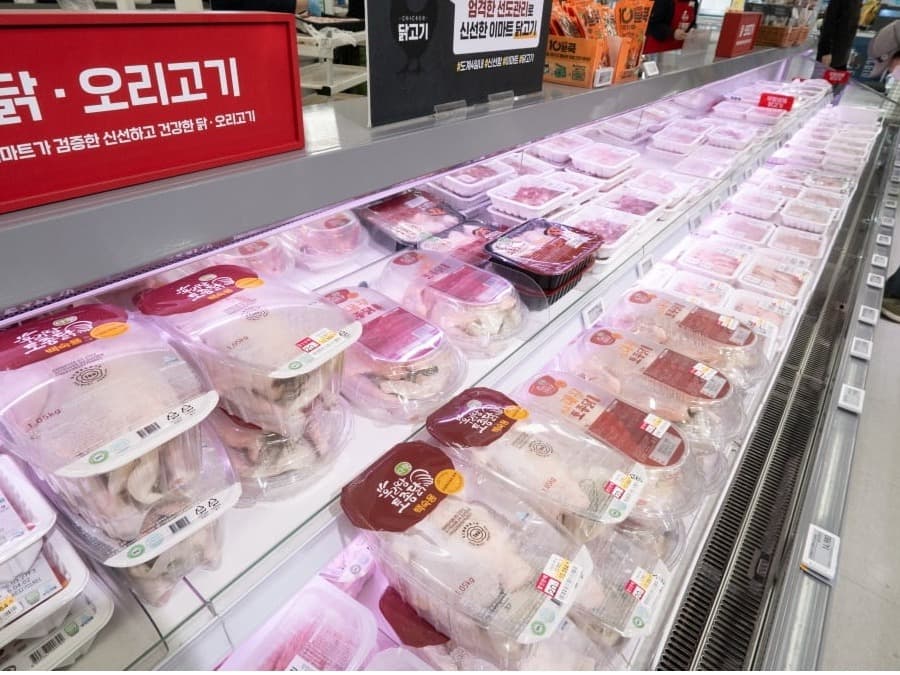
Chicken Supply Rises, But Cuts Are Short… Mixed Supply and Demand Battle Amidst November Price Drop
The broiler market in November is expected to face increasing downward price pressure due to the rise in slaughter volume. However, it is difficult to conclude that the overall supply and demand in the chicken market has become sufficient based solely on the increase in supply.
2026.11.6
SPECIAL FOCUS
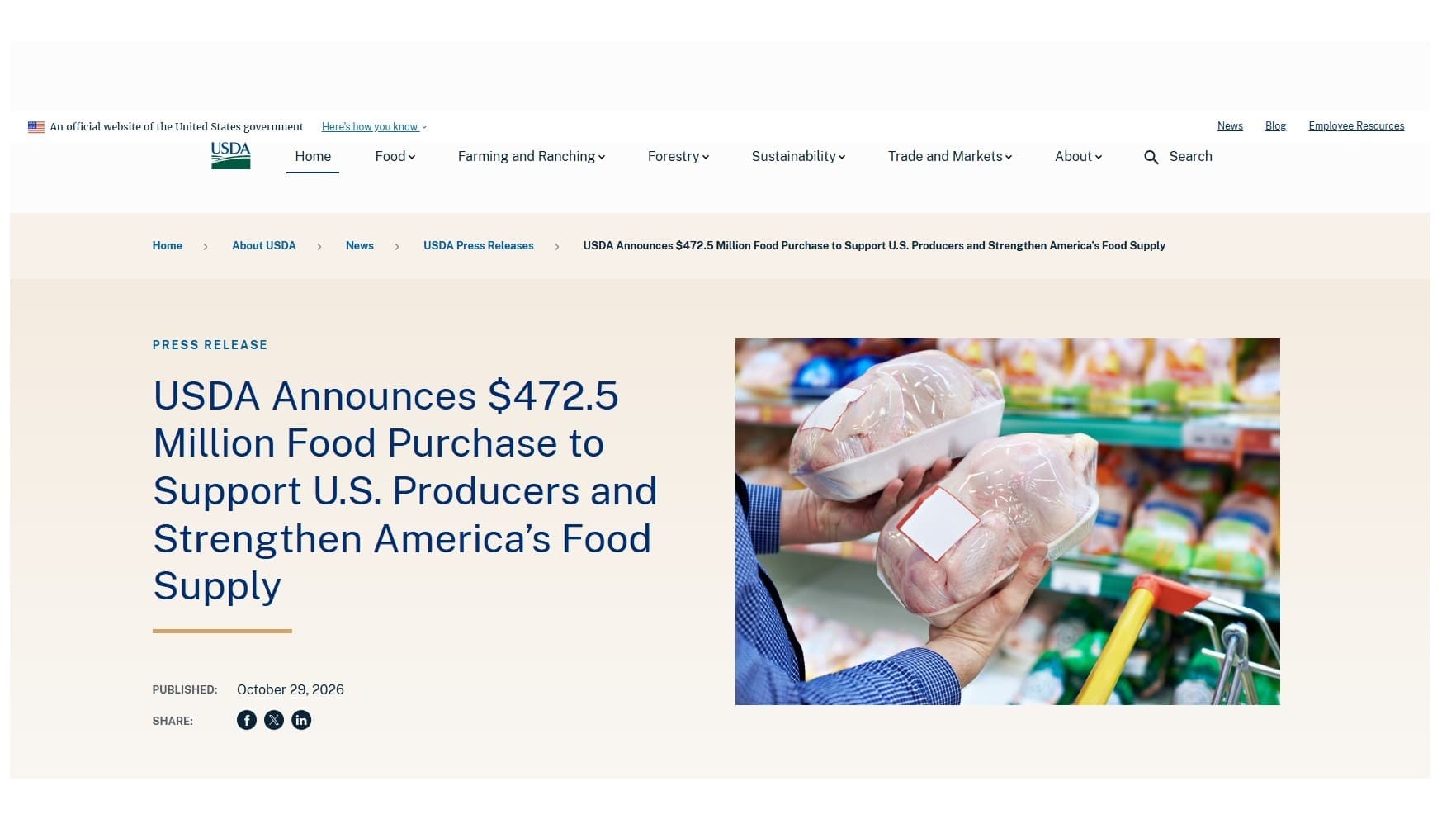
U.S. Government to Purchase $41 Million in Pork… Supporting Market Stabilization for Agricultural, Livestock, and Fisheries Products
The U.S. Department of Agriculture (USDA) announced a plan to purchase agricultural and fishery products worth a total of $472.5 million, including $41 million in pork and $20 million in chicken.
2026.11.1
SPECIAL FOCUS
Pork trotters restaurants have changed, but the raw material market remains the same… What is the way out for domestic pork trotters?
The fact that domestic pig's trotters are not selling does not mean that consumption of pig's trotters has disappeared. The issue lies in how well the market supplying the raw materials has kept pace with the changes in how consumers select and order pig's trotters.
2026.10.29