
SPECIAL FOCUS
U.S. to Foster Small and Independent Meat Processors… $5 Billion in Loan Guarantees and $57 Million in Subsidies
USDA Announces Support Measures for Processing Facility Expansion at Three-Day Intervals… Combining Private Loan Guarantees and Direct Subsidies
The U.S. government is launching large-scale loan guarantees and direct subsidies to support the facility expansion of small and independent meat processing companies. The approach involves the government guaranteeing loans to assist companies seeking to establish or expand processing facilities with financing, and supporting the expansion of processing capacity through separate subsidy programs.
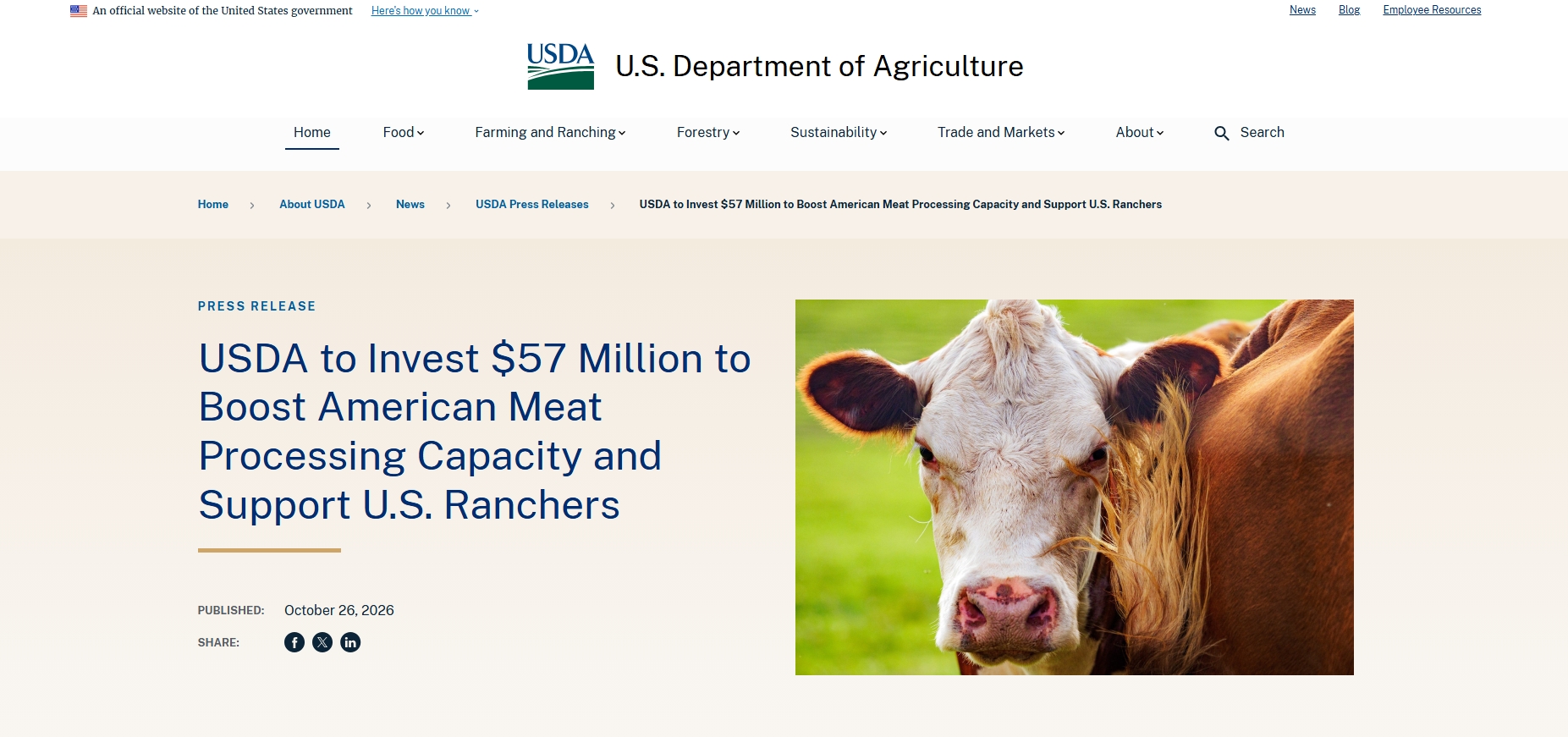
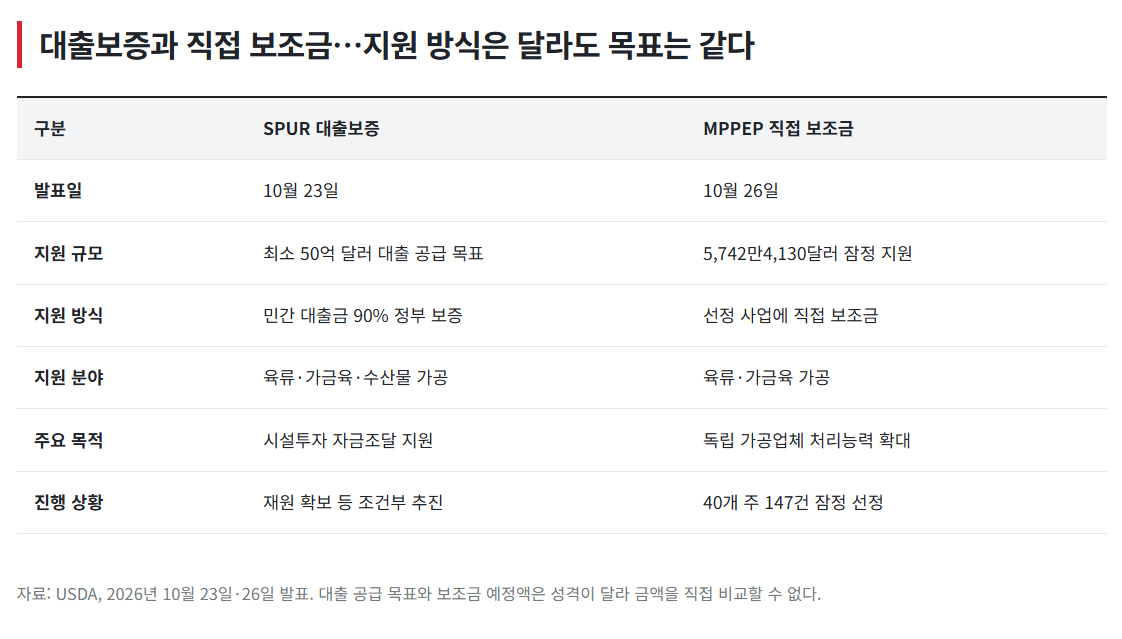
Following the announcement on the 23rd of a loan guarantee program for meat, poultry, and seafood processing facilities worth at least $5 billion, the U.S. Department of Agriculture (USDA) announced on the 26th that it plans to provide a total of $57,424,130 in subsidies to 147 meat and poultry processing projects being pursued in 40 U.S. states.
Although the two policies differ in their support methods, they share the same goal: to expand the processing capacity of facilities and diversify sales channels for livestock farms, while simultaneously promoting competition in the meat processing market.
Why Focus on ‘Independent Meat Processors’
The U.S. government’s expansion of support for small and independent meat processors is driven by market concentration in the meat processing industry and issues regarding accessibility to local processing facilities.
Even if livestock farmers raise cattle or pigs, a lack of available slaughtering and processing facilities restricts their sales channels. In particular, if there are few processing facilities within the region, farmers face the burden of having to rely on limited buyers or use facilities in distant areas.
The term "Independent Processors" used by the USDA does not simply refer to small-scale companies. It is a concept that includes whether the ownership and operation of the company are conducted independently.
In particular, the Meat and Poultry Processing Expansion Program (MPPEP) applies the condition of being "independently owned and operated" to private operators. Company size and independence of ownership and operation are distinct criteria.
While the SPUR loan guarantee program also sets the expansion of small-scale, independent, and regionally based processing facilities as its policy goal, the eligibility criteria for the two programs are not identical. SPUR includes seafood processing facilities and imposes separate restrictions on companies with significant market dominance.
$5 billion loan guarantee… Government guarantees 90% of loans
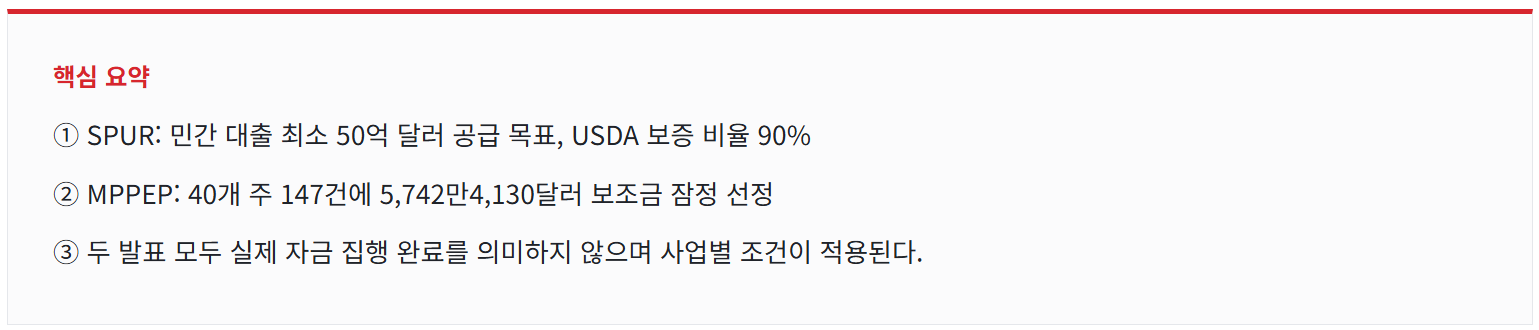
SPUR (Strengthening Processing for U.S. Ranchers), announced by the USDA on the 23rd, is a loan guarantee program that supports the financing of investment for meat, poultry, and seafood processing facilities.
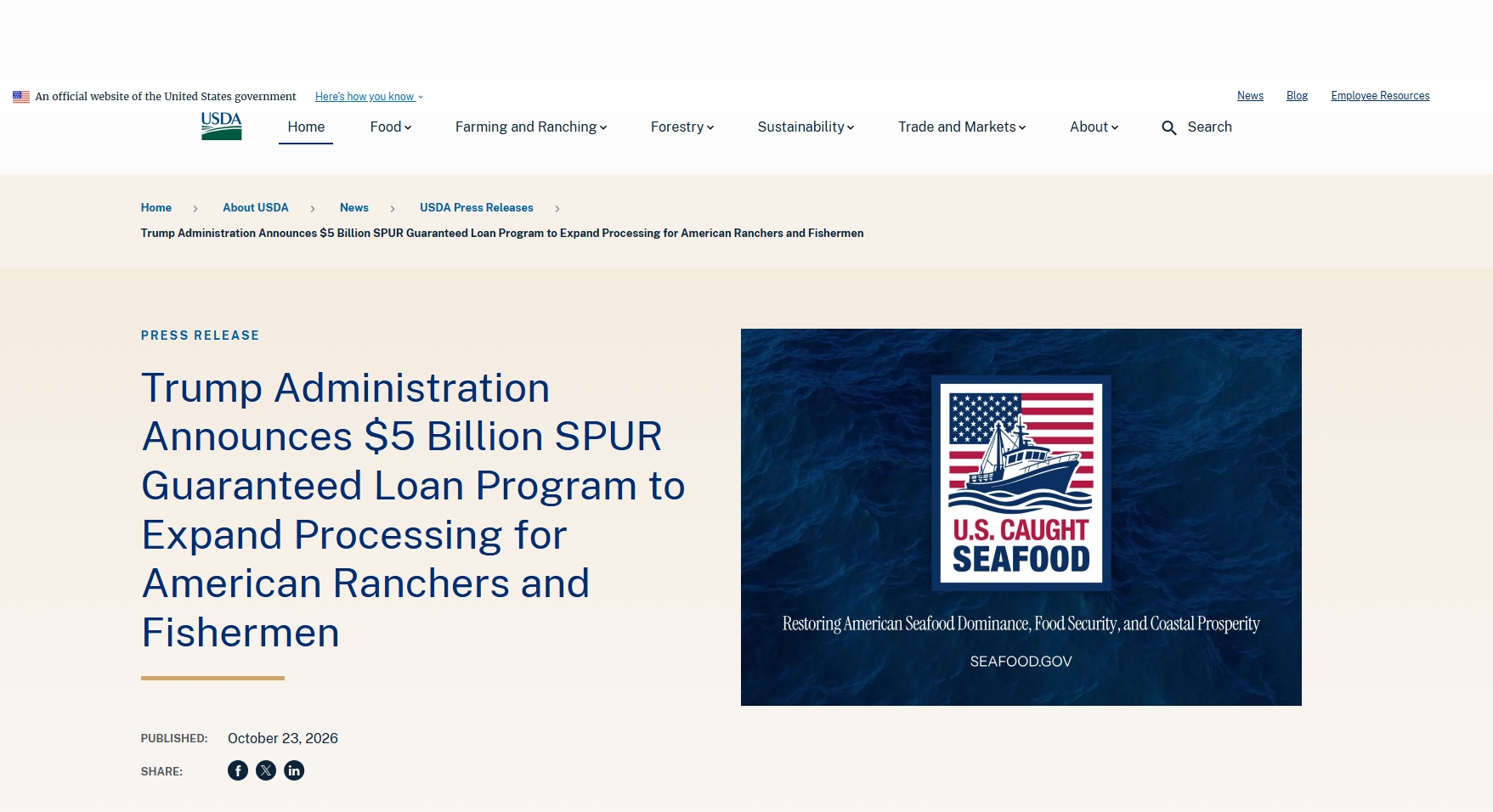
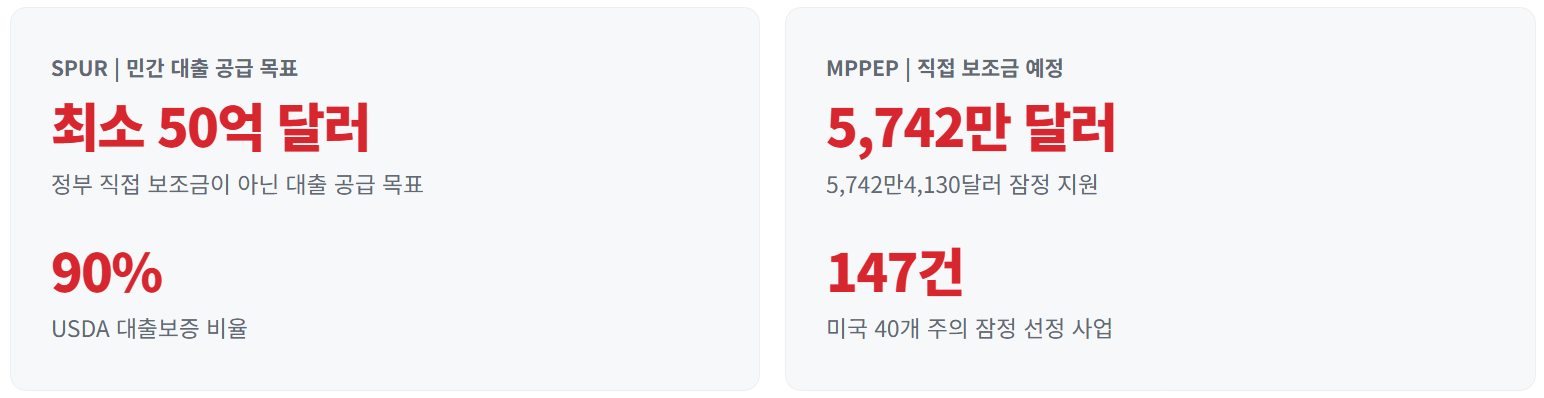
The goal is to provide at least $5 billion in loans, and the government does not directly provide this amount as a grant. If a processing company obtains a loan from an eligible private financial institution, the USDA guarantees 90% of the loan amount.
The maximum loan amount per borrower is $175 million. Depending on the loan terms, repayment of principal and interest may be deferred for up to two years, and the loan term cannot exceed 40 years. The interest rate is determined through negotiation between the financial institution and the borrower.
Eligible projects include the construction of new processing facilities, the expansion, restart, or renovation of existing facilities, the introduction of processing equipment, and investments in technologies related to food safety and worker safety.
The USDA business guidelines also specify restrictions on support for processors with significant market dominance. However, specific eligibility requirements must follow individual business regulations and screening criteria.
Loan guarantee support is subject to relevant conditions, such as congressional approval and securing funds, and does not mean that $5 billion in loans has already been provided.
SPUR Guarantee Fees Noticed in the Federal Register
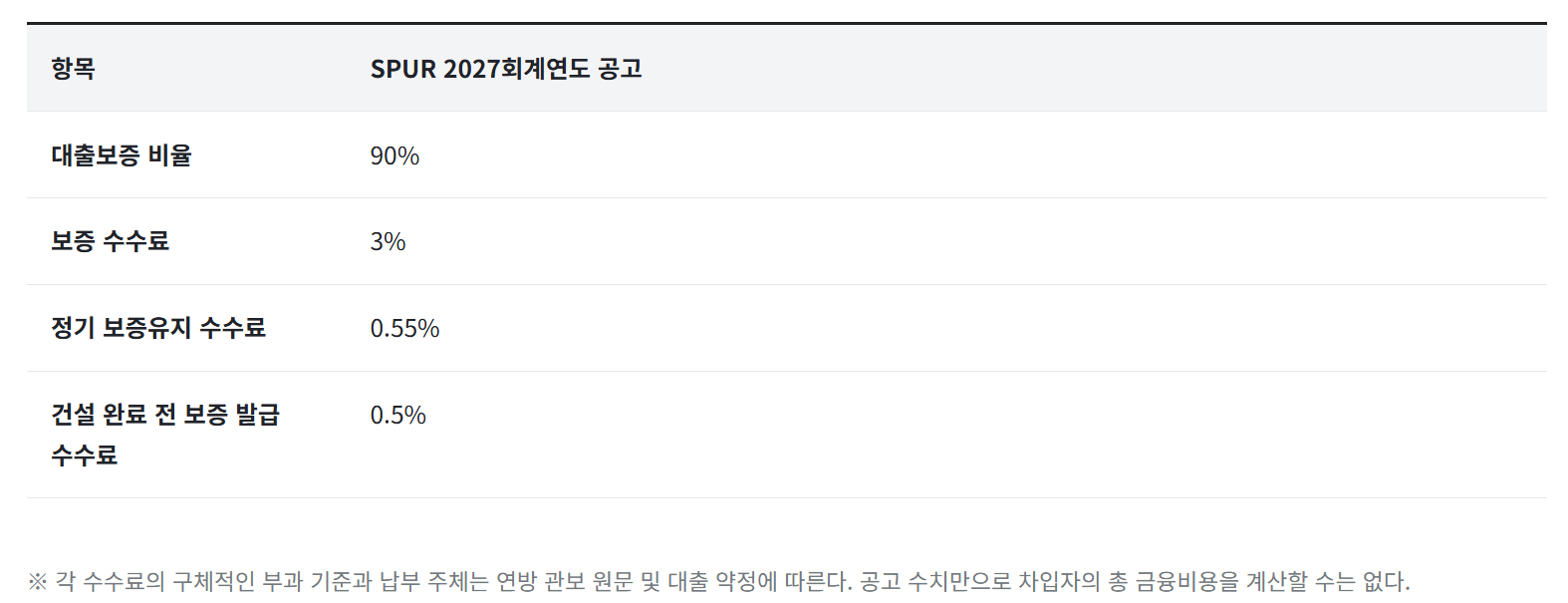
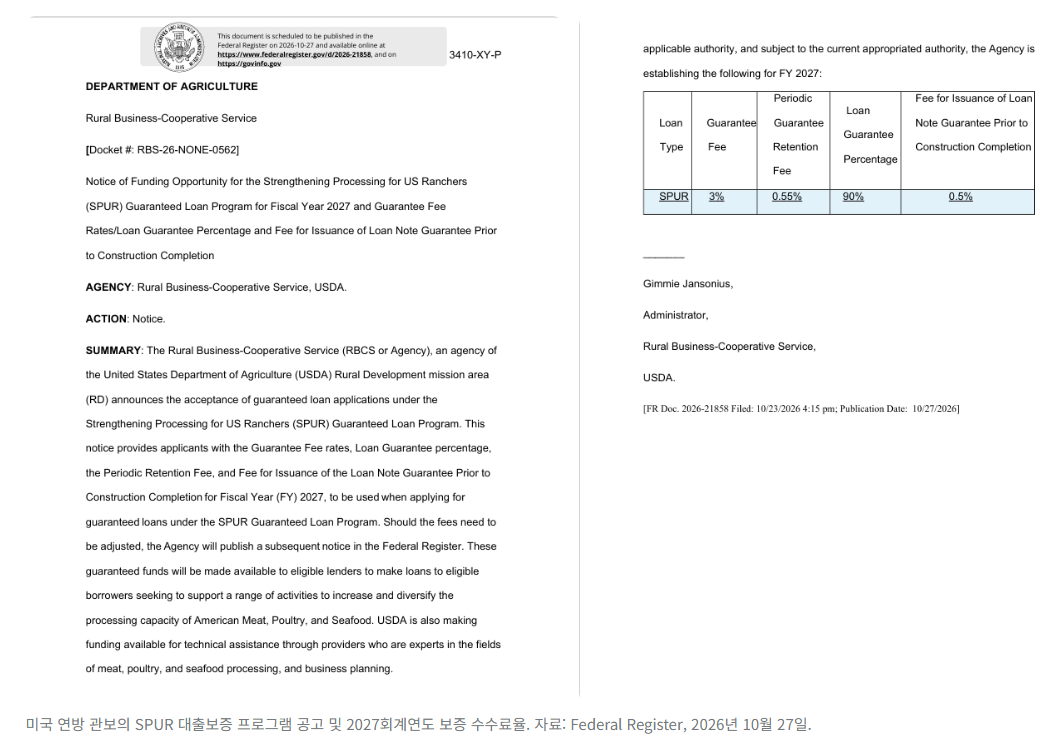
The U.S. Federal Register notice dated the 27th also presented fee rates related to SPUR loan guarantees for fiscal year 2027. In addition to a loan guarantee ratio of 90%, a guarantee fee of 3%, a time guarantee maintenance fee of 0.55%, and a pre-construction loan certificate guarantee issuance fee of 0.5% were specified. These are separate items from the loan interest rate applied to the borrower.
$57.42 million in direct subsidies for 147 cases across 40 states
On the 26th, the USDA also announced plans for additional support through the Meat and Poultry Processing Expansion Program (MPPEP).
The plan is to provide a total of $57,424,130 in subsidies to 147 projects being pursued in 40 U.S. states. MPPEP is a system that provides direct subsidies to selected projects to expand the processing capacity of independent processors.
Eligible recipients include qualified independent businesses, producer-owned cooperatives, non-profit organizations, local governments, and related agencies. According to the USDA, grants provided to independent processors through the MPPEP have exceeded $200 million to date.
This announcement does not establish a new subsidy system, but rather a plan for additional support through existing projects. Furthermore, the 147 projects are not those with final support confirmed, but are provisionally selected projects contingent on budget allocation by the Assembly.
Expansion of processing facilities expands shipping options for livestock farms
While the direct beneficiaries of the two policies are processing companies, the effect the USDA expects extends to expanding sales opportunities for livestock farmers.
An increase in local slaughtering and processing facilities could potentially provide livestock farmers with additional options for selling their animals or outsourcing processing. Independent processing companies can also enhance their processing capacity through facility expansion and equipment modernization.
The USDA expects that this expansion of the processing base will contribute to promoting market competition and strengthening the resilience of the meat supply chain.
However, the actual scale of new facility construction and expansion, as well as the increase in processing capacity, have not yet been confirmed. The effectiveness of the policy must be evaluated based on future loan supply performance and the final selection and execution results of subsidy projects.
Korea Also Supports Modernization of Slaughterhouse and Processing Facilities… Operated Centered on Loans
Meanwhile, in Korea, the Ministry of Agriculture, Food and Rural Affairs is also supporting the construction, renovation, and equipment modernization of slaughtering and processing facilities through the ‘Support Project for Livestock Product Slaughtering and Processing Enterprises.’
According to the 2026 project guidelines, funding for the modernization of slaughter and processing facilities consists of 70% loans and 30% self-financing. Operating funds for slaughter and processing businesses are managed through a separate loan program, and eligibility criteria and limits vary by specific project.
The Ministry of Agriculture, Food and Rural Affairs announced that it is revising its business guidelines to provide loan interest rates for slaughterhouse facility improvements at an annual level of 2 to 3% and to prioritize the selection of applicants who introduce energy-efficient facilities and equipment, such as solar power.
However, since facility funding is provided through loans, business operators must secure equity capital and repay the loans. Further verification of the actual situation is required to determine how much the self-financing and repayment conditions influence the actual investment decisions of small and medium-sized meat processing companies.
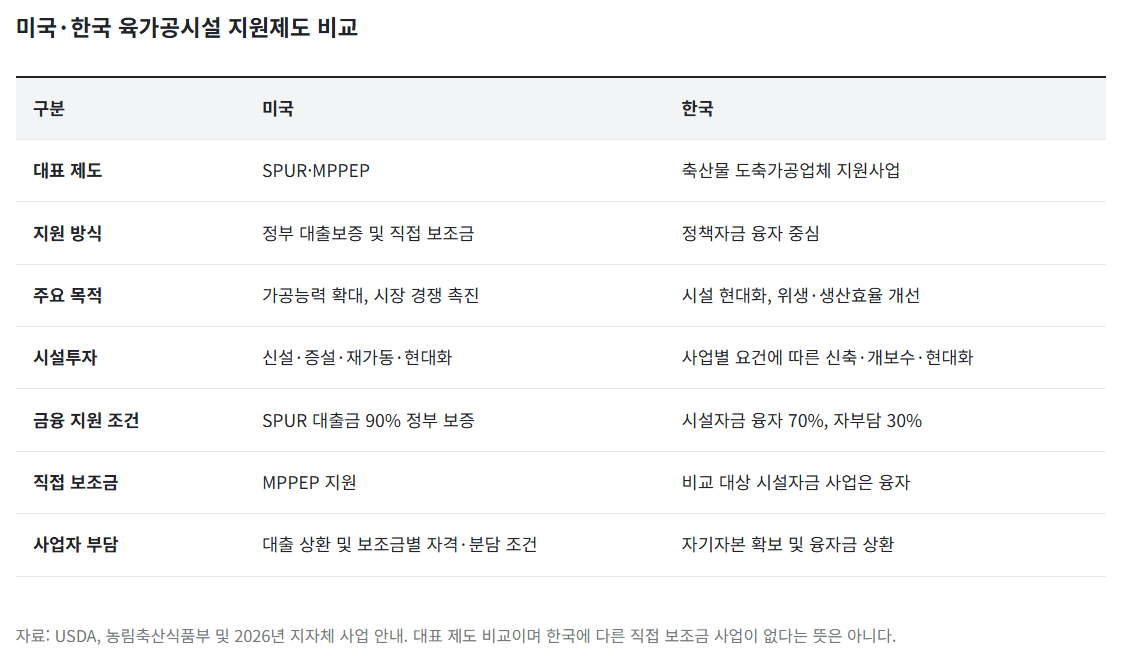
Both the United States and Korea support the modernization of slaughterhouses and meat processing facilities and the expansion of processing capacity, but their methods differ. The United States combines loan guarantees and direct subsidies to encourage investment by independent processors, whereas Korea's representative support program for slaughterhouses and processing facilities is operated primarily through policy fund loans.
Domestically as well, it is necessary to examine how well existing support systems meet the demand for facility investment from small and medium-sized meat processing companies, and how self-financing and repayment conditions influence actual investment decisions.
Sources and Original Text
USDA announces SPUR on October 23
USDA Announces MPPEP on October 26
- #수입육
- #축산물
- #정책
Related Content
SPECIAL FOCUS
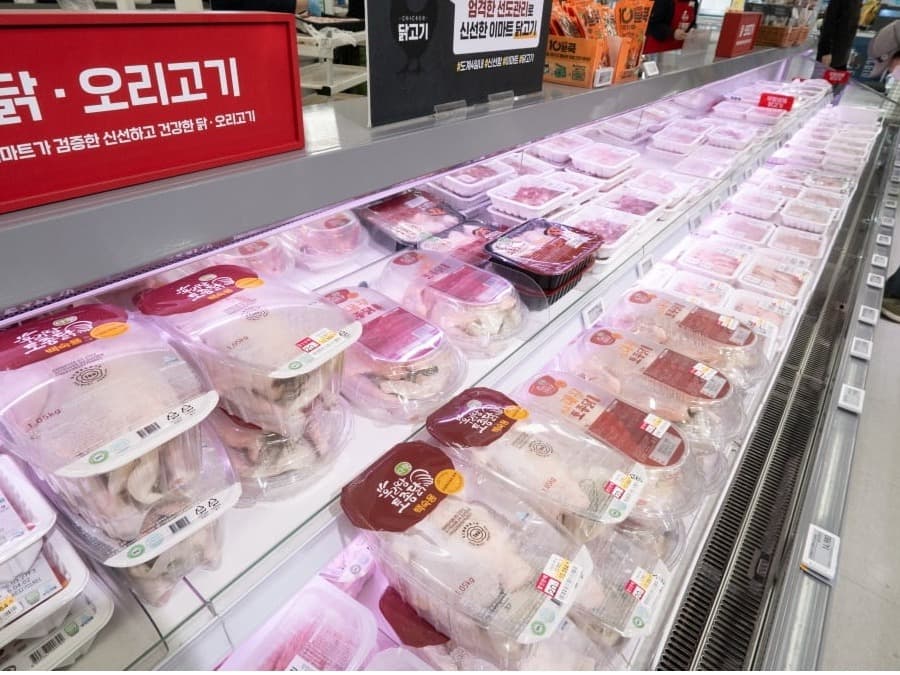
Chicken Supply Rises, But Cuts Are Short… Mixed Supply and Demand Battle Amidst November Price Drop
The broiler market in November is expected to face increasing downward price pressure due to the rise in slaughter volume. However, it is difficult to conclude that the overall supply and demand in the chicken market has become sufficient based solely on the increase in supply.
2026.11.6
SPECIAL FOCUS
U.S. Government to Purchase $41 Million in Pork… Supporting Market Stabilization for Agricultural, Livestock, and Fisheries Products
The U.S. Department of Agriculture (USDA) announced a plan to purchase agricultural and fishery products worth a total of $472.5 million, including $41 million in pork and $20 million in chicken.
2026.11.1
SPECIAL FOCUS
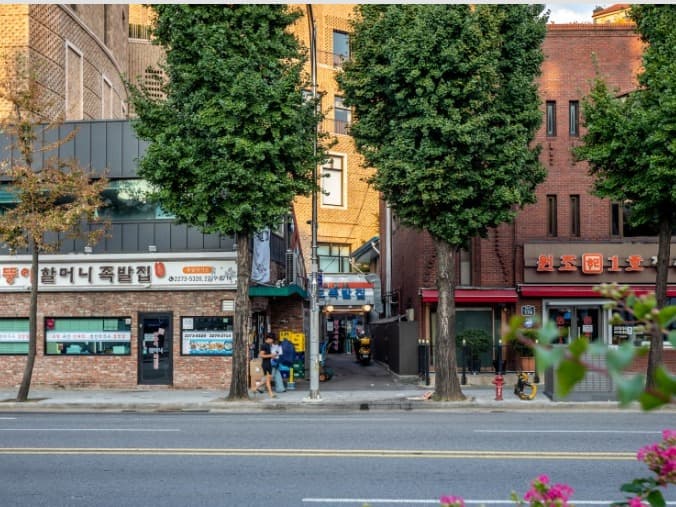
Pork trotters restaurants have changed, but the raw material market remains the same… What is the way out for domestic pork trotters?
The fact that domestic pig's trotters are not selling does not mean that consumption of pig's trotters has disappeared. The issue lies in how well the market supplying the raw materials has kept pace with the changes in how consumers select and order pig's trotters.
2026.10.29