
Issues & Insights
Loose Supply and Demand, Yet Strong Pork Prices… ‘Decoupling’ in the Pork Market
Pork prices surpass 7,000 won in September despite record-high imports and a 29% increase in domestic inventory.

A rare phenomenon is appearing in the pork market.
Despite rising domestic pork inventories and record-high imports, wholesale pork prices continue to remain strong. This refers to the so-called situation where basic market supply and demand conditions—such as production, imports, inventory, and consumption—move in different directions from actual carcass prices.Decoupling of Supply and Demand Fundamentals and Carcass PricesIt is a phenomenon.
According to the Korea Animal Products Quality Evaluation Institute, the nationwide wholesale price of pork (excluding carcass and Jeju cuts) surpassed the 7,000 won mark on September 2nd, rising from 6,850 won per kg on September 1st to 7,010 won. It then recorded 7,046 won on the 3rd, 7,038 won on the 4th, 7,101 won on the 7th, and 7,088 won on the 8th. This indicates that high pork prices around 7,000 won have continued throughout September.
Pork prices have been strong since the first half of this year.
According to the Korea Meat Export Association, the average carcass price from January to August this year was in the 5,900 won range per kg, 3.3% higher than the 5,713 won recorded during the same period last year. From January to June, high prices continued on a monthly basis, with the exception of March. Subsequently, in July, the price fell to 6,236 won from 6,365 won last year, and in August, it was approximately 6,400 won, falling below last year's 6,602 won; however, starting from the end of August, prices returned to a steep upward trend.
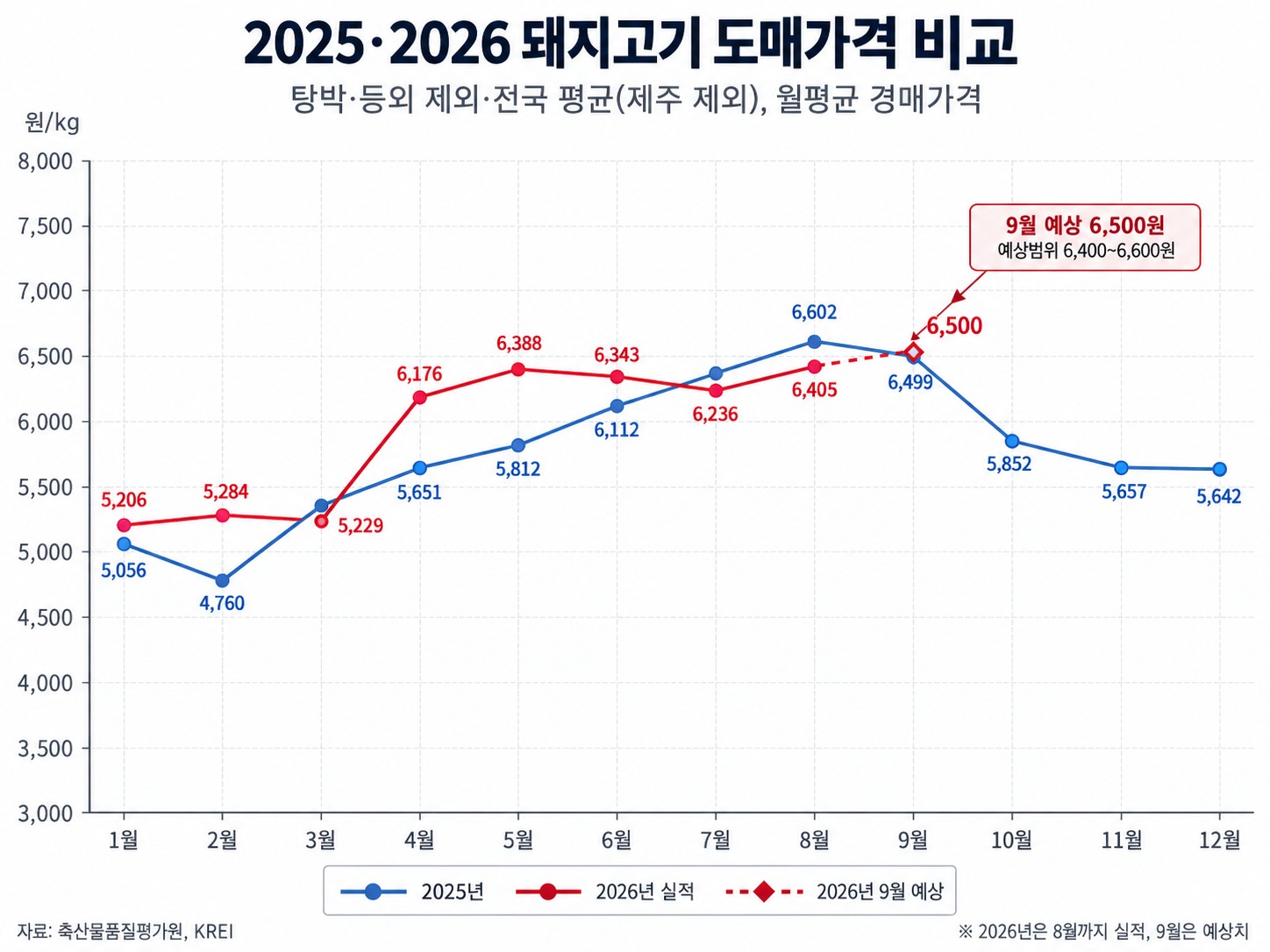
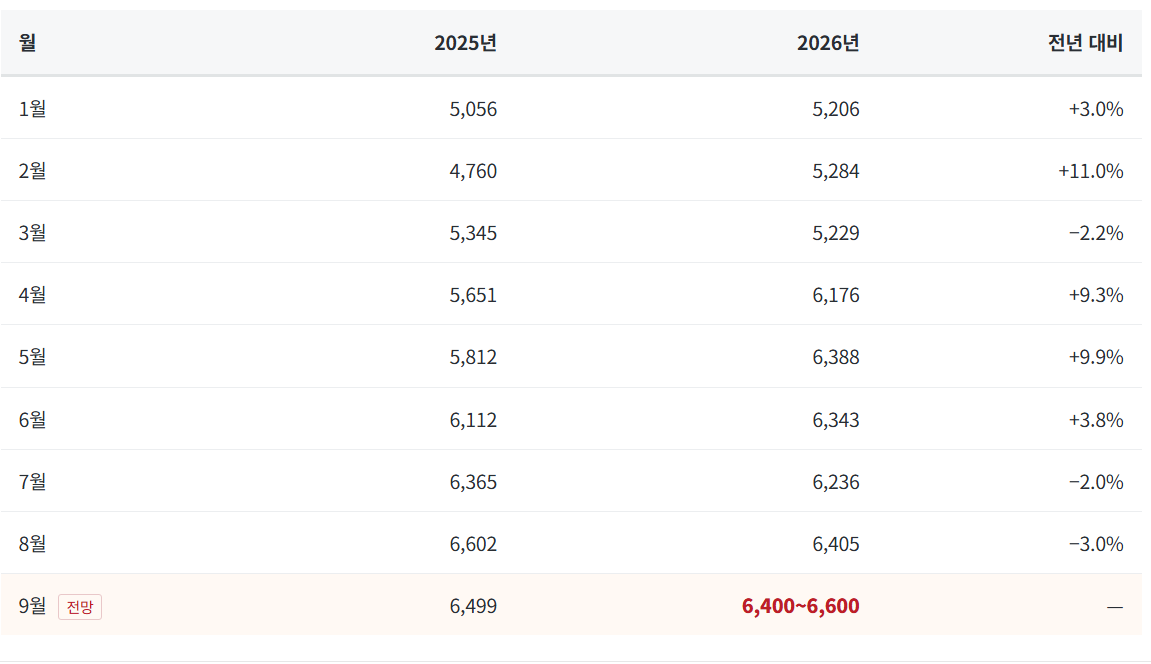
The problem is that it is difficult to explain such high pork prices solely by a shortage of the overall pork supply. The cumulative number of pigs slaughtered through August of this year is similar to that of last year. Although approximately 150,000 pigs were culled in the first quarter of this year due to the outbreak of African Swine Fever (ASF), the Meat Distribution and Export Association analyzes that the cumulative slaughter volume itself has already recovered to last year's level.
Imports are increasing, and inventories of domestic and imported products are also rising.
Imported pork actually increased significantly.Cumulative pork imports from January to August this year increased by 15.4% compared to the same period last year, marking the highest level ever recorded for that period. If the current trend continues, there is even a possibility that the record annual import volume of 463,521 tons set in 2018 could be surpassed.
There is also a significant amount of imported meat inventory.As of June, the inventory of imported pork meat stood at 192,424 tons, up 20.8% from 159,348 tons during the same period last year.
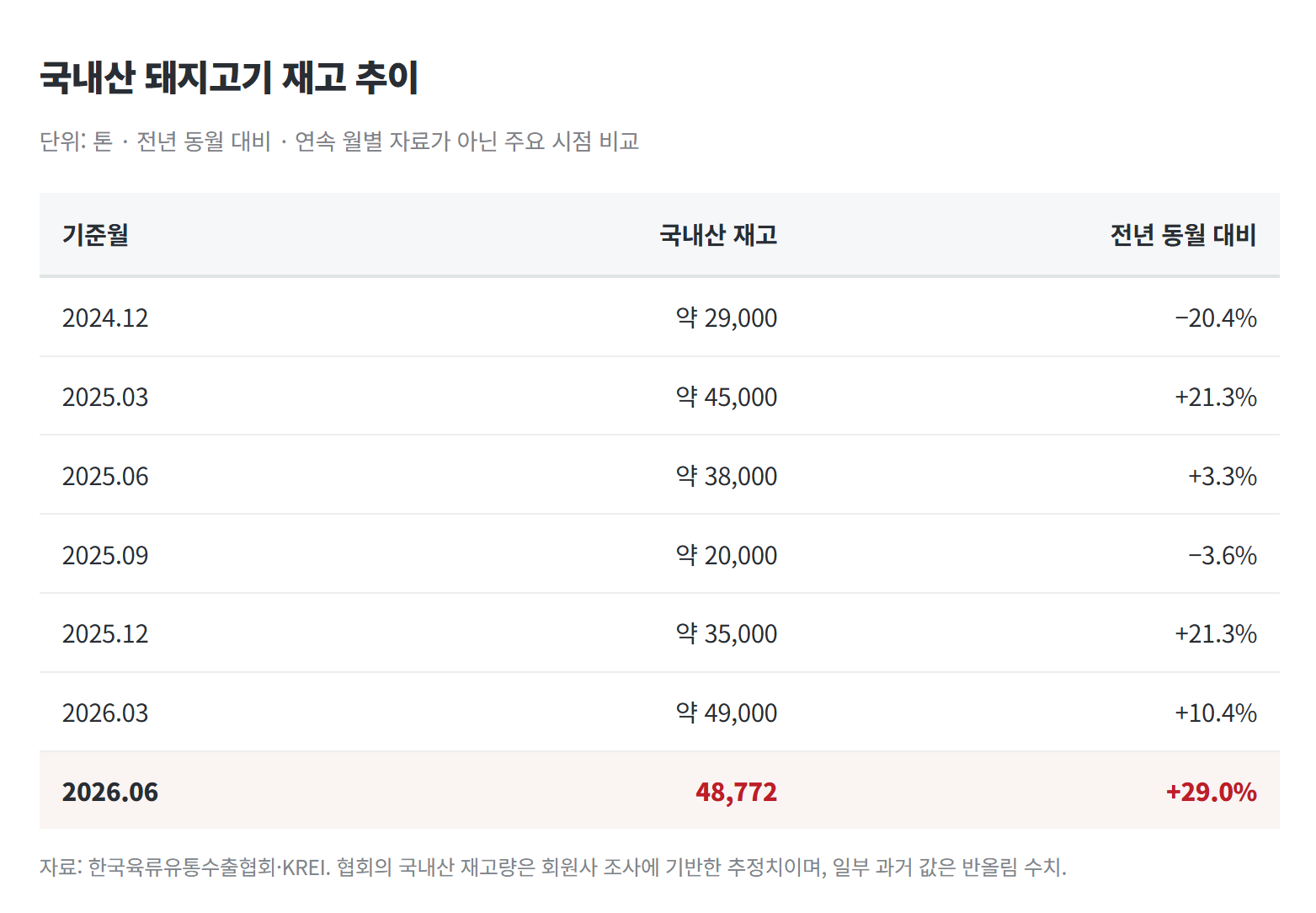
The situation for domestic products is similar. The domestic pork inventory for June, estimated by the Korea Meat Export Association based on surveys of member companies, is48,772 tons, a 29% increase compared to the same month last yeardid.
Pork hind leg and loin piled up, while pork belly and neck decreased.
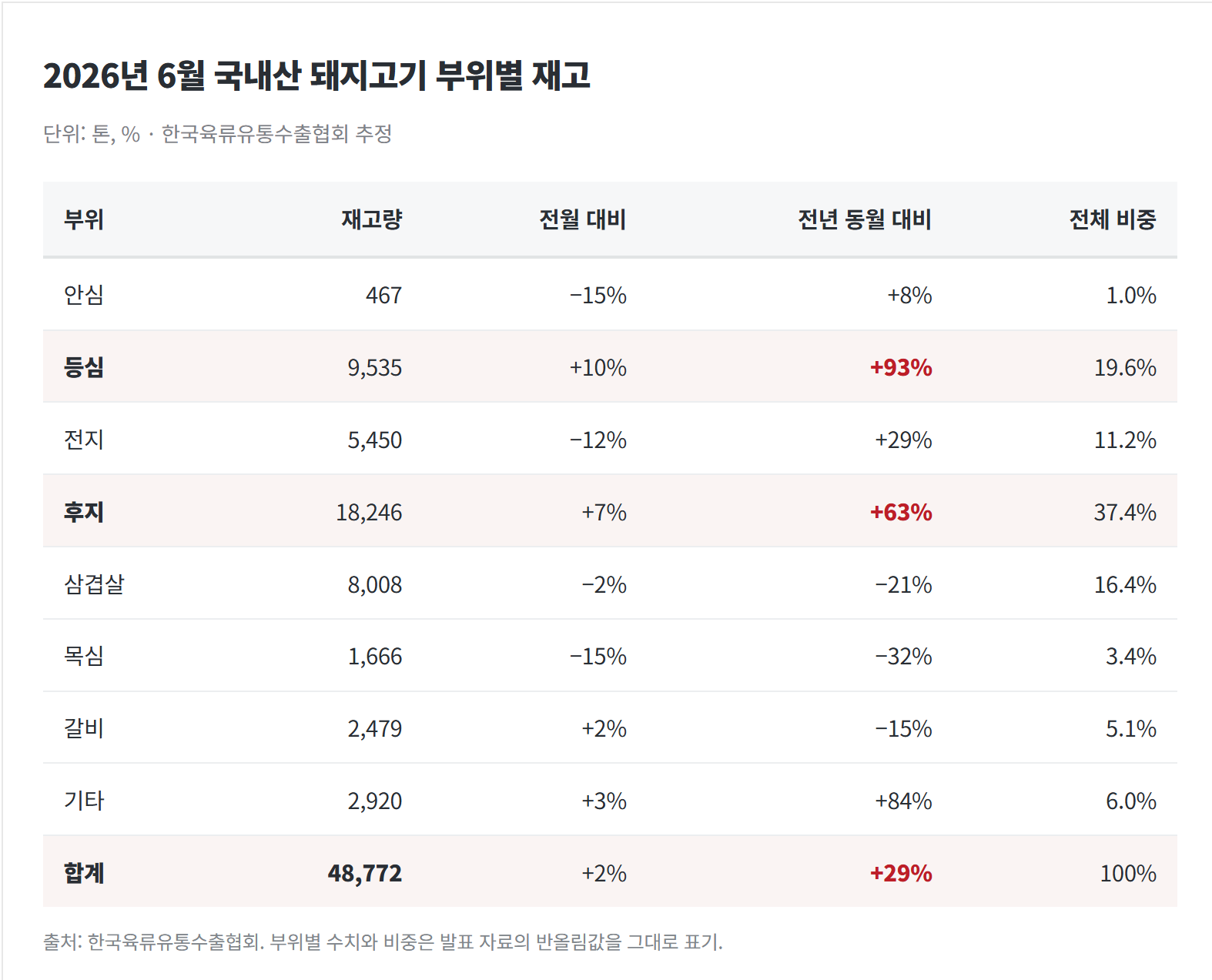
However, there were significant differences by cut. Fuji inventory rose 63% from the previous year to 18,246 tons, while loin surged 93% to 9,535 tons. Shoulder also increased by 29% to 5,450 tons.
On the other hand, pork belly inventory fell 21% from the previous year to 8,008 tons, and pork neck also decreased by 32% to 1,666 tons. Ultimately, it is hind leg and loin that are driving the overall increase in inventory. These two cuts alone amount to 27,781 tons, accounting for approximately 57% of the total domestic inventory.
This is also why it is difficult to characterize the recent pork market simply as being in a state of ‘over-supply.’ This is because, while the overall supply of pork is sufficient, inventory is concentrated in cuts with low consumption, whereas preferred cuts such as pork belly and neck are showing relatively different supply and demand conditions.
In terms of consumption as well, no clear signs of a favorable trend sufficient to support the current high pork prices have been confirmed.
The Meat Distribution and Export Association analyzed that the 29% increase in domestic inventory, despite slaughter volumes similar to the previous year, indicates that overall pork consumption was not buoyant this year. In particular, it assessed that despite high carcass prices, prices for lower cuts such as the hind leg actually declined, and sales of pork belly and neck were not active enough to offset this.
The total supply and the volume of the carcass market are not the same.
Then why are carcass prices strong even as inventory and import volumes have increased?
What should be noted here isThe ‘total supply of pork’ and the ‘volume of the carcass market that determines immediate prices’ are not the same.The point is that
Domestic stock and imported meat stored in cold storage affect the overall supply of the domestic pork market, but they are not the volume that directly determines the wholesale price of pigs on any given day. The wholesale price of pigs is determined based on the price of carcasses traded in the actual wholesale market. The Korea Animal Products Quality Evaluation Institute also separately compiles the wholesale price of pigs as the ‘overall average of carcasses (excluding Jeju).’
Even if the overall pork supply is sufficient, carcass prices can strengthen if short-term shipments and processing volumes decrease or if supply and demand in the wholesale market become tight.
Therefore, even if the overall pork supply is sufficient, carcass prices may strengthen if short-term shipments and processing volumes decrease or if supply and demand in the wholesale market become tight.
In fact, last August, the volume of work decreased due to the closure of slaughterhouses and processing plants for summer vacations and holidays, and the volume of low-priced sales in the market also declined. Prices began to rise again as consumption partially recovered after Liberation Day. Analysis suggests that carcass prices have risen rapidly since the end of August due to a combination of factors, including delays in weight gain caused by the heatwave and adjustments to shipping times ahead of Chuseok.
However, the discrepancy with supply and demand indicators is too large to interpret this as a structural shortage of domestic pork supply. Cumulative slaughter volume through August of this year was similar to last year, while imports increased by 15.4%. Domestic inventory rose by 29%, and imported inventory by 20.8%.
October Pork Cut, ‘Decoupling’ Put to the Test
Going forward, market attention is focused on how long this decoupling will continue.
The Korea Rural Economic Institute (KREI) forecasts that the wholesale price of pork in September will be between 6,400 and 6,600 won per kilogram. This forecast suggests that the current price in the 7,000 won range seen in early September will undergo some adjustment on a monthly average basis, rather than remaining unchanged until the end of the month.
The point in time when price trends are likely to change significantly is October.
KREI projected that the number of pigs slaughtered in October would increase by approximately 9% compared to the previous year, reaching 1.62 million to 1.66 million head. Accordingly, it predicted that the wholesale price of pork in October would fall to 5,600 to 5,800 won per kg. In November, as the number of slaughtered pigs increases by 6.2% compared to the previous year, reaching 1.63 million to 1.67 million head, the price of pork is also expected to drop to 5,400 to 5,600 won.
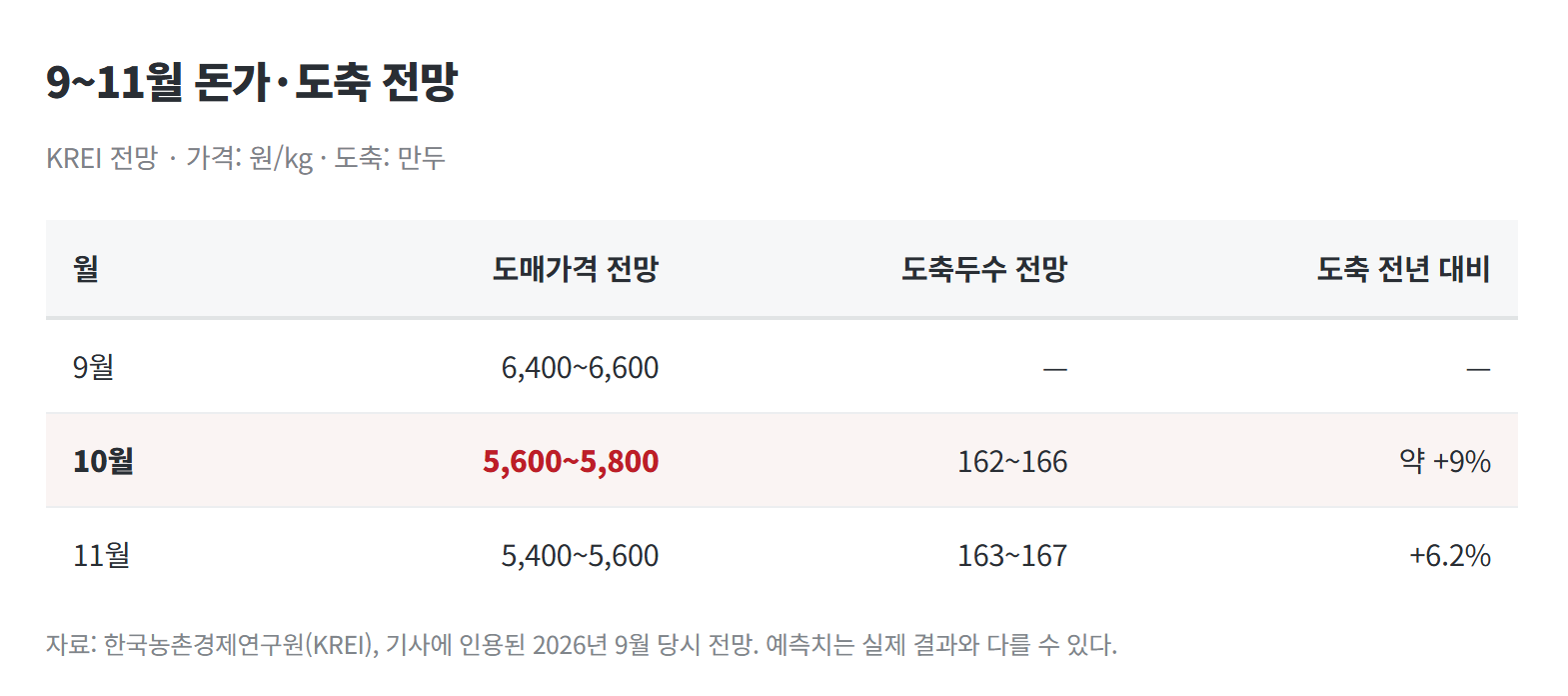
Ultimately, pork prices in October are expected to serve as an important test to confirm the ‘decoupling of supply and demand and prices’ that has emerged this year.
If pork prices fall to the 5,000 won range after slaughter volumes increase as expected and demand during the Chuseok peak season ends, the interpretation that the recent 7,000 won price was a price rally created by short-term shipments and supply and demand in the carcass market, rather than a structural rise stemming from an overall pork shortage, could gain traction.
Conversely, if pork prices hold strong at over 6,000 won even as inventories of imported and domestic meat remain high and slaughter volumes increase, the story changes.
In that case, it is necessary to examine not merely the simple issues of production, import, and consumption volumes, but the very structure that shapes domestic pork prices, including wholesale market auction volumes and proportions, the work patterns of meat processing companies, and supply and demand imbalances by cut.
Attention is focused on whether the unusual ‘price decoupling’ occurring in the pork market this year will continue into October.


- #축산물
- #유통
Related Content
SPECIAL FOCUS
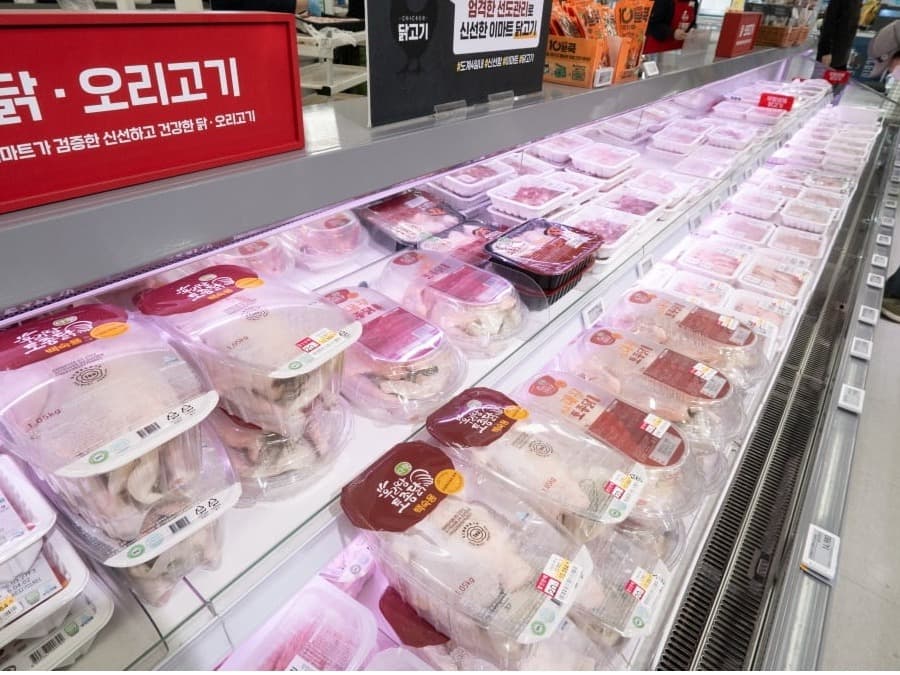
Chicken Supply Rises, But Cuts Are Short… Mixed Supply and Demand Battle Amidst November Price Drop
The broiler market in November is expected to face increasing downward price pressure due to the rise in slaughter volume. However, it is difficult to conclude that the overall supply and demand in the chicken market has become sufficient based solely on the increase in supply.
2026.11.6
terrestrial broadcast
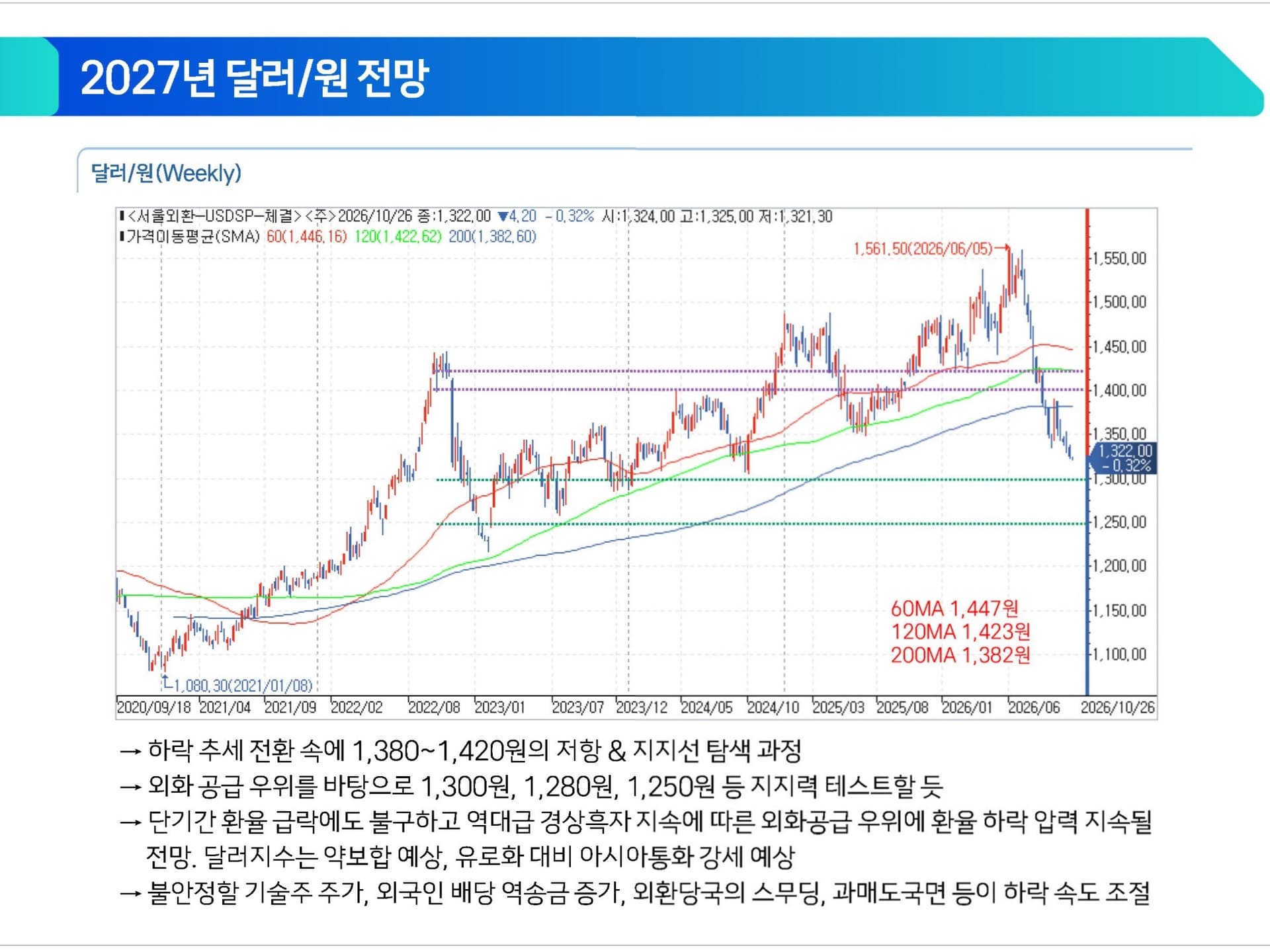
Dollars piling up in Korea… Will the exchange rate head below 1,300 won next year?
If the power to earn dollars is stronger than the demand to buy them, how low will the exchange rate fall? For Jung Mi-young, Director of the Research Center at Samsung Futures, who looks ahead to next year's won-dollar exchange rate, the starting point is the volume of dollars flowing into Korea.
2026.11.2

Issues & Insights
Japan Begins Review of ASF Localization for Spanish Pork
The Japanese government is officially reviewing whether to apply "zoning," a system that classifies risk levels by region, to Spanish pork imports that have been suspended due to the outbreak of African Swine Fever (ASF).
2026.11.2